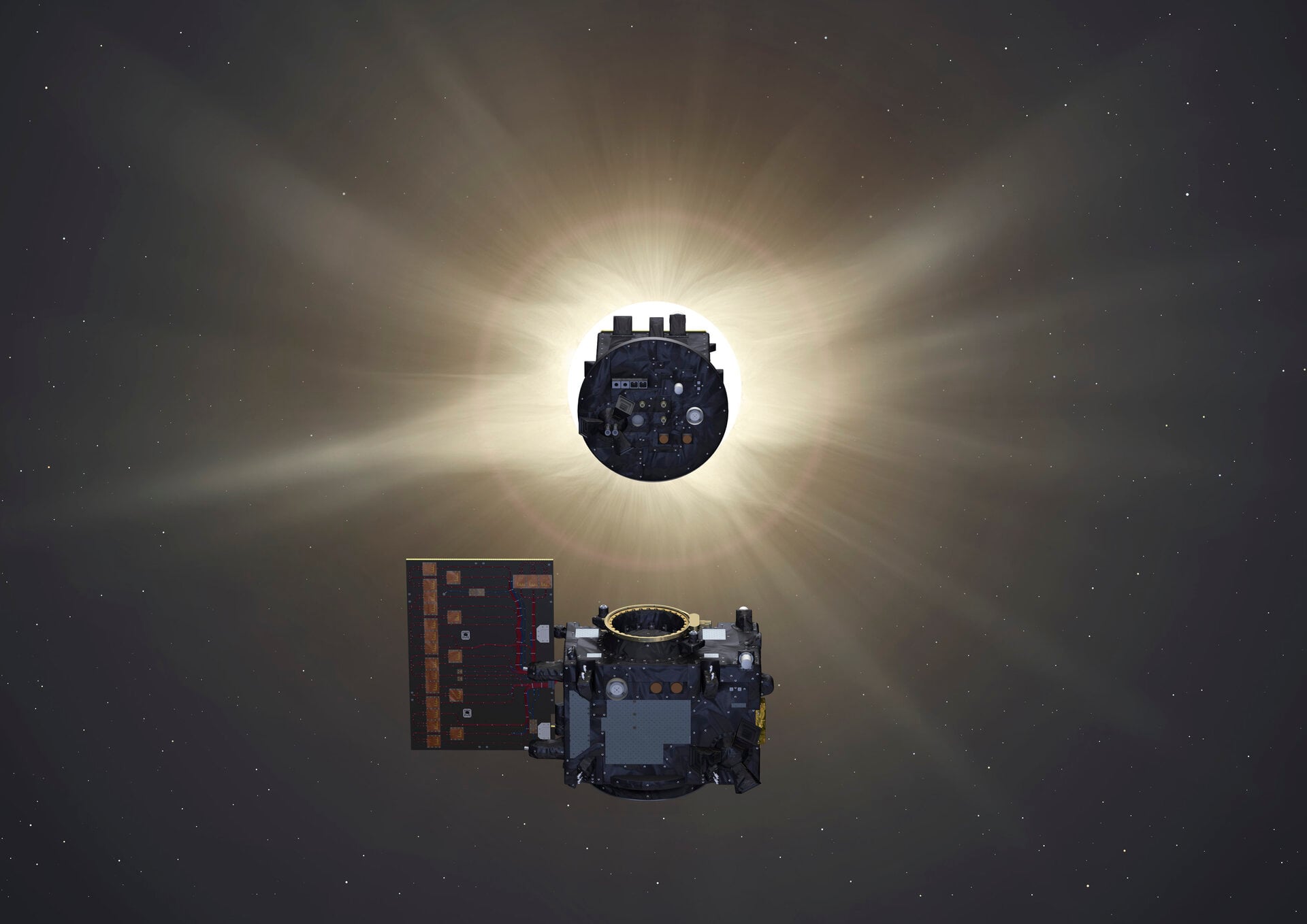
The European Space Agency's Proba-3 mission, launched in 2024, has demonstrated the first successful results from a revolutionary space-based coronagraph that creates artificial solar eclipses on demand. The free-flying spacecraft pair works by positioning one craft to occult the sun's bright disk while a second instrument observes the solar corona without atmospheric interference.
This breakthrough gives solar researchers direct access to study coronal dynamics and space weather generation with unprecedented clarity. Scientists no longer depend on rare natural eclipse windows to observe the sun's outer atmosphere. Instead, Proba-3 delivers continuous viewing of regions normally hidden by the sun's overwhelming glare.
First science results, published in the Astrophysical Journal Letters, reveal new insights into how space weather originates in the corona. The mission opens new pathways for understanding solar wind acceleration and coronal mass ejections, events that can disable satellites and power grids on Earth.
The achievement validates decades of conceptual work on formation-flying spacecraft. Proba-3 proves that two independent vehicles can maintain precise geometric alignment in orbit to accomplish observations impossible for single spacecraft. This approach promises to reshape how astronomers study not just the sun, but other stellar objects requiring extreme contrast imaging.