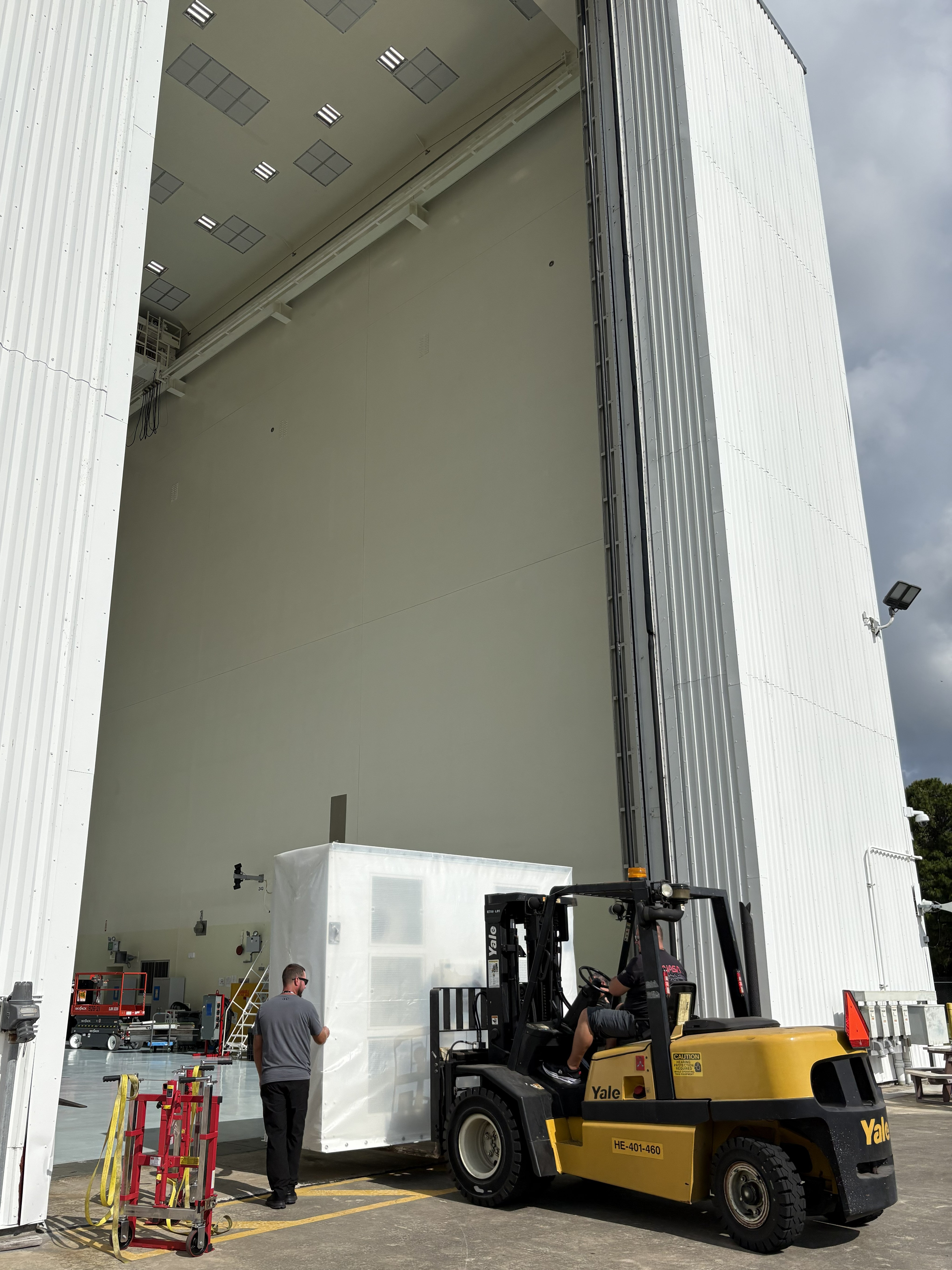
NASA received critical ground support equipment at Kennedy Space Center on April 27 to prepare for launch processing of the Nancy Grace Roman Space Telescope. Technicians at the Payload Hazardous Servicing Facility offloaded eight high-efficiency particulate air (HEPA) wall modules, each weighing 1,800 pounds. These modules upgrade the facility's clean room systems to meet the stringent contamination control standards required for Roman's sensitive optical components and instruments.
The HEPA modules represent essential infrastructure for one of NASA's next-generation astronomy missions. Roman will conduct wide-field infrared observations across billions of light-years, mapping dark energy, detecting exoplanets, and studying stellar populations with unprecedented sensitivity.
The arrival of this equipment marks progress in the mission's ground processing timeline. Kennedy Space Center's PHSF specializes in preparing spacecraft and instruments for spaceflight in controlled environments where dust, particles, and chemical contaminants could damage sensitive hardware. The upgraded clean room capacity ensures Roman receives the contamination control environment necessary before integration onto its launch vehicle.
Roman's deployment represents a major step forward for NASA's astrophysics program, building on the success of the James Webb Space Telescope with new scientific capabilities in infrared astronomy and exoplanet characterization.