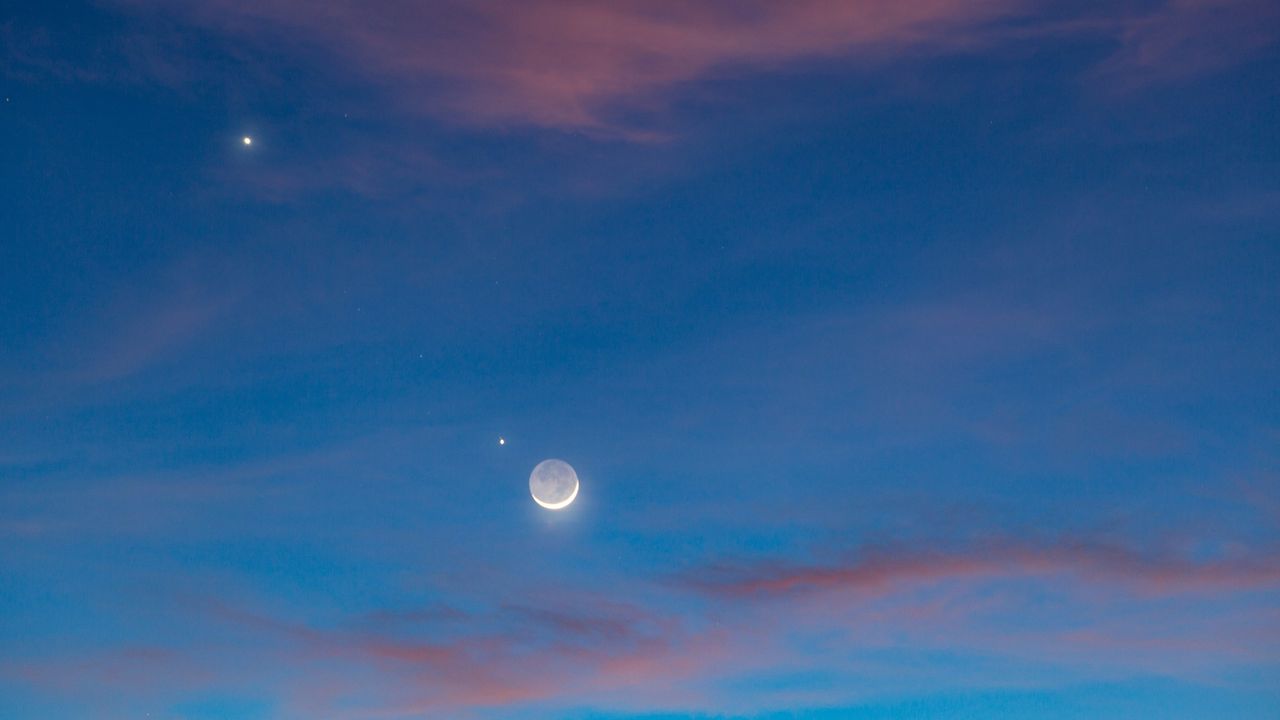
Three bright planets will dominate Earth's night sky throughout May. Venus, Jupiter, and Mercury create viewing opportunities for naked-eye observers across both hemispheres.
The celestial display peaks when all three planets align within a compact region of sky. Venus reaches its brightest phase during the month, shining at magnitude minus 4.3. Jupiter follows as the second-brightest object. Mercury completes the trio, though it requires binoculars or a small telescope to spot easily given its proximity to the horizon and the sun's glare.
The moon joins this planetary parade multiple times. On May 23, a thin crescent moon passes near Venus. Days later, the moon sweeps past Jupiter and Mercury in succession, creating the month's standout photo opportunity.
Observers should scan the western sky after sunset during twilight hours. Best viewing occurs roughly 30 to 60 minutes after the sun dips below the horizon. Higher elevations and locations with minimal light pollution yield superior results. No optical equipment is required for Venus and Jupiter, though dark-adapted eyes enhance visibility of dimmer objects.
This alignment stems from orbital mechanics. Venus, Earth, and Jupiter follow their respective paths around the sun, occasionally positioning themselves in Earth's line of sight. Such configurations occur predictably. The May display rewards patient skywatchers with views of our planetary neighborhood.