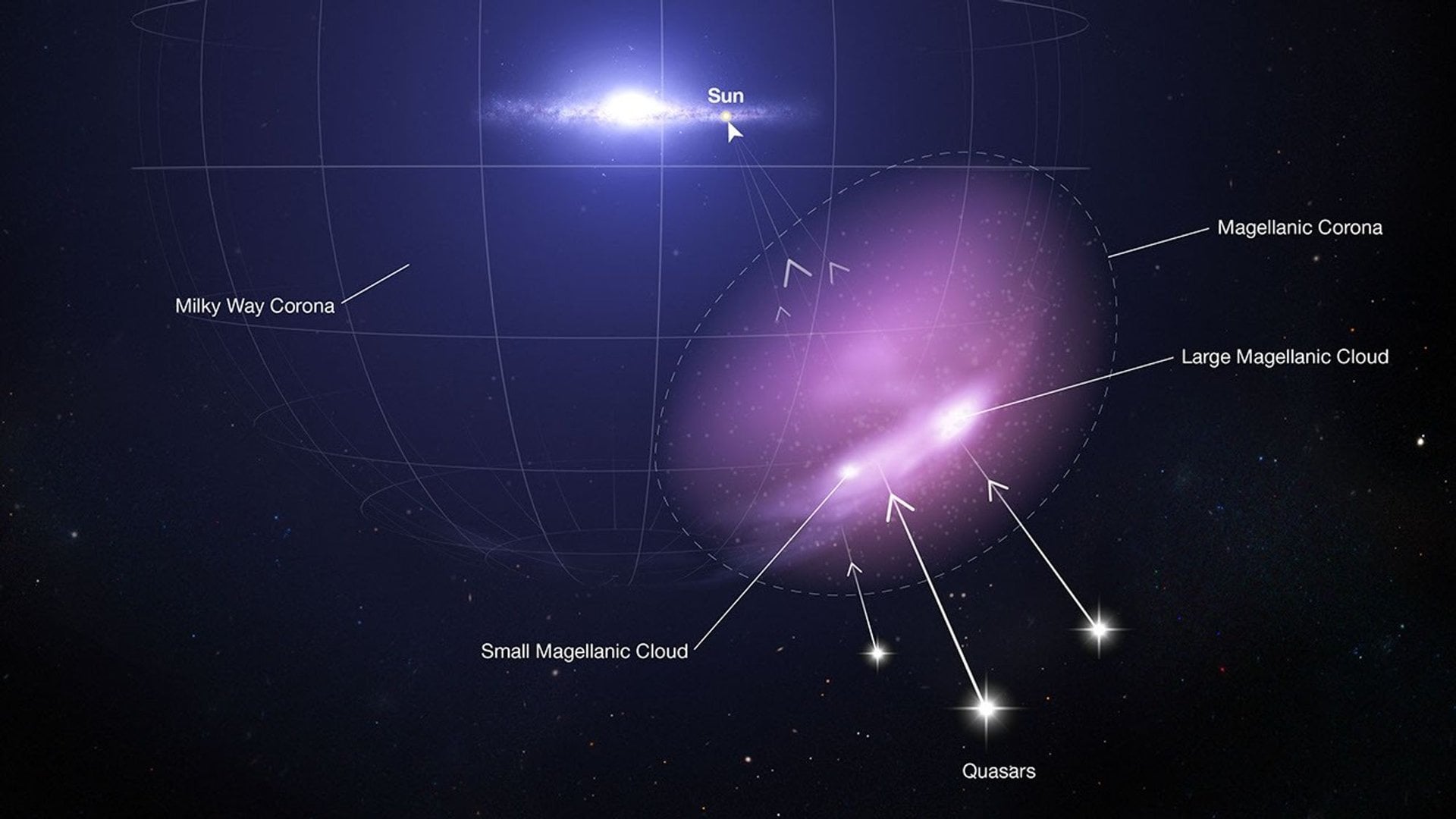
Astronomers debate whether the Large Magellanic Cloud orbits the Milky Way for the first or second time. This question matters enormously for understanding our galaxy's evolution, since the LMC's massive gravity well disrupts galactic structure with each passage.
Scott Lucchini, Jiwon Jesse Han, Sapna Mishra, and Andrew J. Fox led research addressing this fundamental question. Their findings, posted to arXiv as a pre-print, analyze orbital mechanics and gravitational interactions between the two galaxies.
The LMC sits as our most massive satellite galaxy, orbiting at roughly 160,000 light-years from Earth. Its sheer size means every close approach reshapes the Milky Way's disk and halo. Previous passages would have left detectable signatures in our galaxy's structure.
Evidence for a first-time approach relies on modeling the LMC's trajectory backward through space and time. Simulations show whether current positions and velocities place the satellite on its inaugural approach or a return orbit. The implications reshape models of galactic mergers and long-term gravitational dynamics.
This research enters heated debate among astrophysicists. Understanding the LMC's orbital history directly informs theories about how large galaxies grow and transform over billions of years.