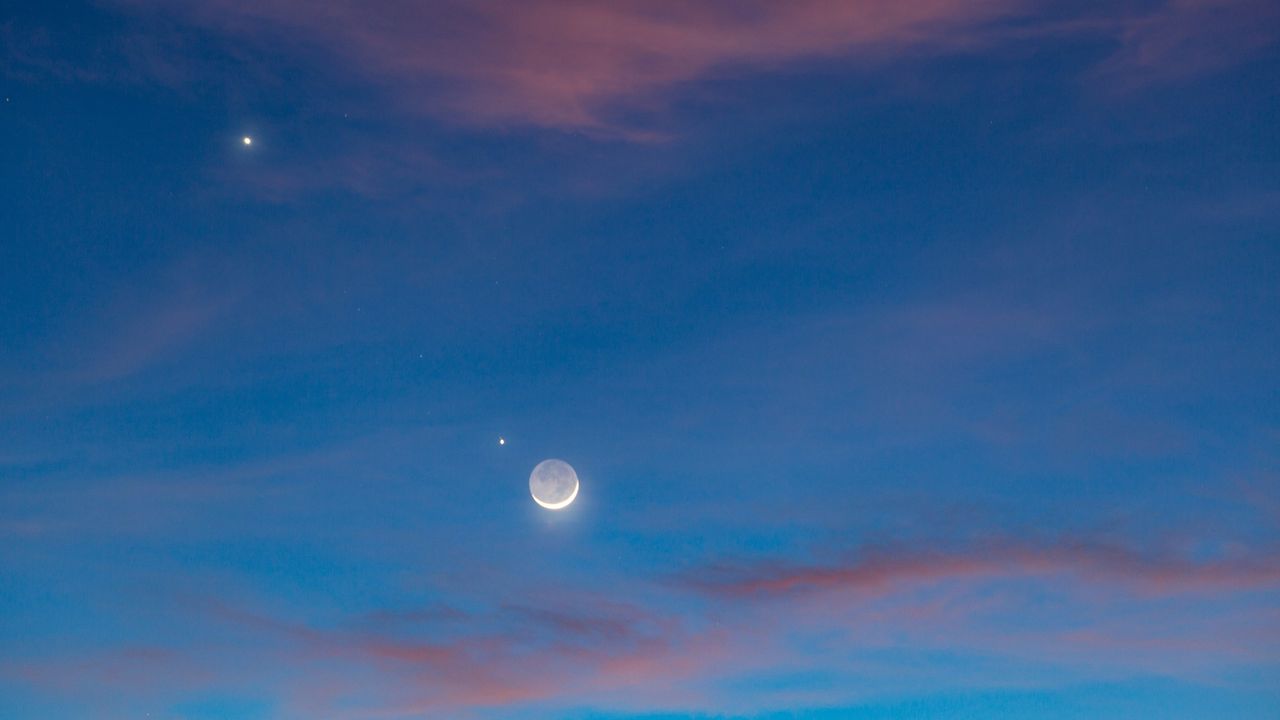
Three bright planets will dominate May's night sky, offering naked-eye viewing opportunities throughout the month.
Venus reaches peak brightness and dominates the western evening sky after sunset. Jupiter follows, visible in the southwestern region. Mercury joins the display lower on the horizon, completing a rare three-planet alignment that observers can track across multiple weeks.
The Moon will pass near these planets at various points during May, creating dramatic conjunctions. On specific dates, the crescent Moon will pair with Venus, then Jupiter, then Mercury as it orbits Earth. These lunar encounters make the planets easier to locate and provide stunning photo opportunities.
Best viewing occurs within 30 to 60 minutes after sunset, before the sky fully darkens. Observers need clear western horizons and minimal light pollution. No binoculars or telescopes required. Venus and Jupiter shine bright enough to spot from urban areas, though Mercury demands darker skies and precise positioning.
This planetary parade results from orbital mechanics. Earth, Venus, Jupiter, and Mercury occupy similar regions of their respective orbits, creating a rare geometric alignment visible from Earth's surface. Such displays occur irregularly, making May a valuable opportunity for skywatchers.