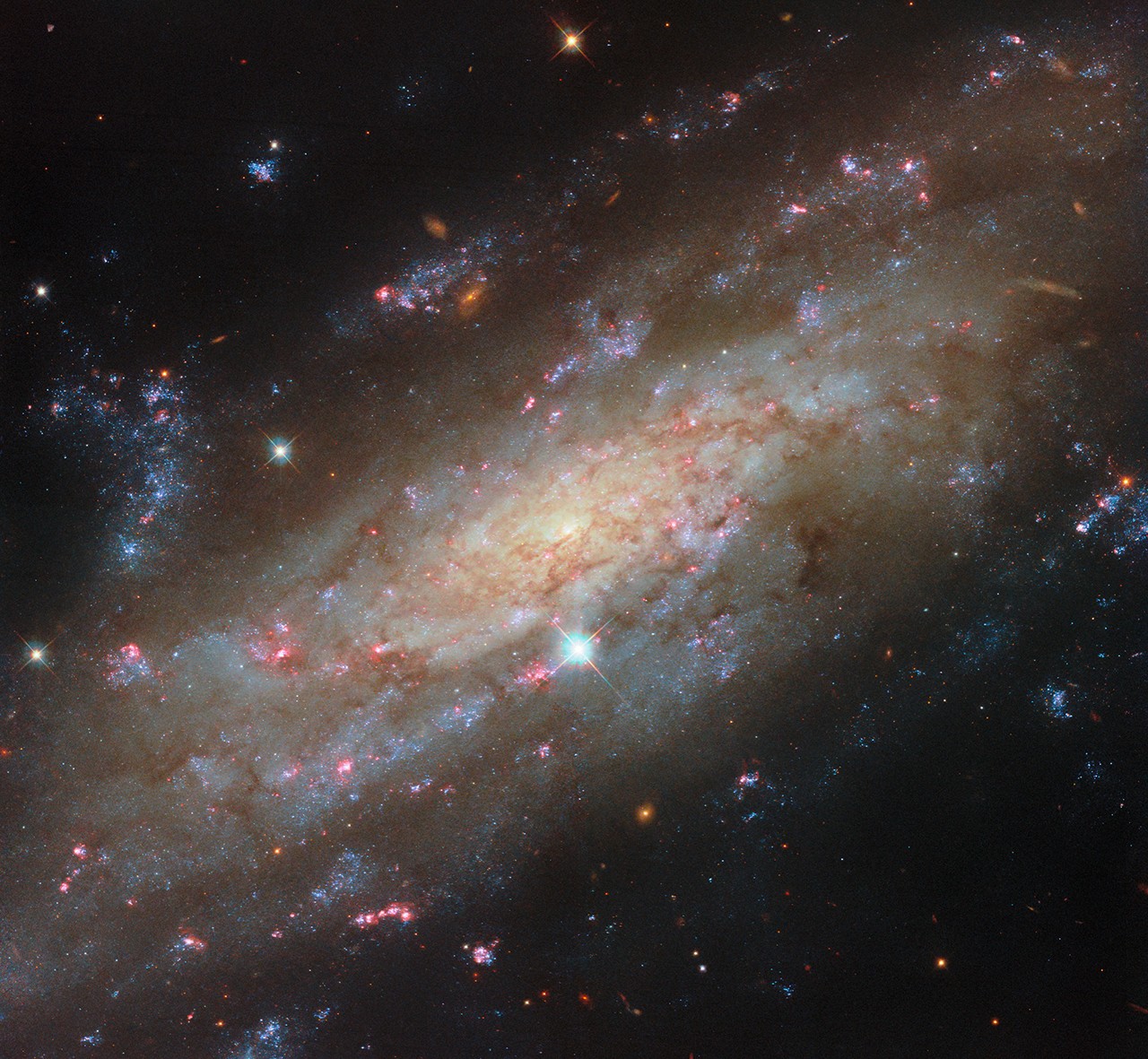
NASA's Hubble Space Telescope captured a detailed image of NGC 3137, a spiral galaxy located 53 million light-years away in the constellation Antlia. The photograph reveals dense clusters of stars spiraling across the galaxy's disk, offering astronomers a nearby laboratory to study how stars form and die throughout galactic history.
The Hubble observations provide researchers with a rare opportunity to examine stellar populations at various ages within a single galaxy. NGC 3137's structure, defined by its prominent spiral arms, allows scientists to trace the relationship between galactic dynamics and star formation rates. The proximity of this galaxy in cosmic terms makes it an ideal target for detailed spectroscopic analysis and long-exposure imaging that would be impossible for more distant systems.
The image demonstrates Hubble's continued capability to resolve individual stars and star clusters even at tens of millions of light-years away. These observations contribute to a broader understanding of galactic evolution across the universe's history. Astronomers can use such nearby galaxies as reference points to interpret observations of more distant, younger galaxies and piece together how spiral structures evolved over billions of years.