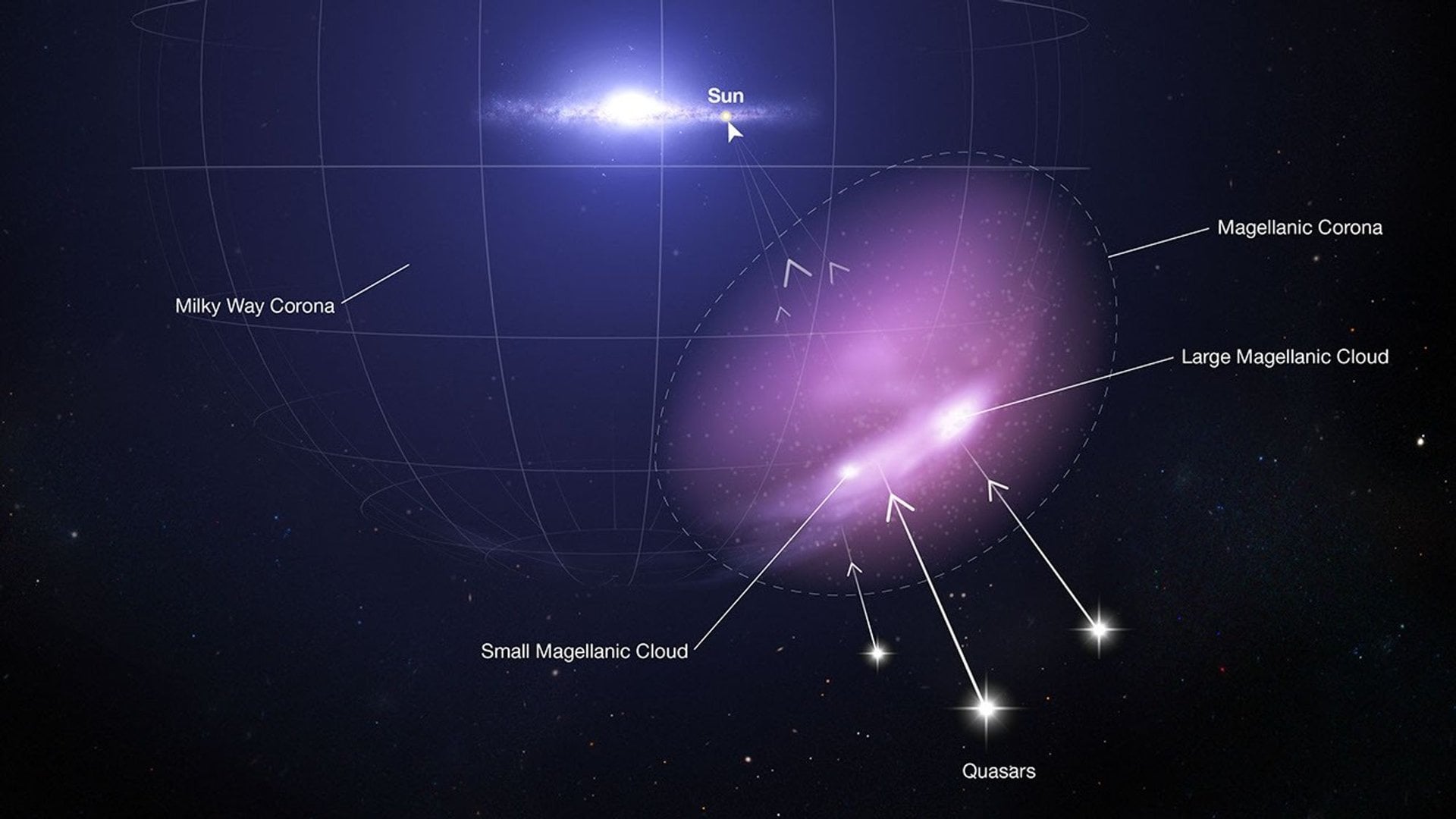
Astrophysicists debate whether the Large Magellanic Cloud approaches the Milky Way for the first or second time, a question with profound implications for galactic evolution. The LMC, our galaxy's most massive satellite, exerts tremendous gravitational influence during close encounters, disrupting stellar structures across billions of years.
A new paper by Scott Lucchini, Jiwon Jesse Han, Sapna Mishra, and Andrew J. Fox, available on arXiv, examines orbital histories and dynamical modeling to resolve this question. The team's research carries weight because each scenario produces vastly different predictions for how the Milky Way's disk, halo, and stellar streams formed and evolved.
If the LMC is a first-time visitor, it entered our galactic neighborhood relatively recently in cosmic terms. A second passage would mean the LMC previously orbited the Milky Way, left, and returned, leaving gravitational fingerprints embedded in our galaxy's structure today.
Understanding the LMC's history illuminates fundamental questions about galactic assembly and the role satellite galaxies play in shaping their hosts. The answer also constrains models of dark matter distribution and helps astronomers reconstruct the Milky Way's past encounters with other massive systems.