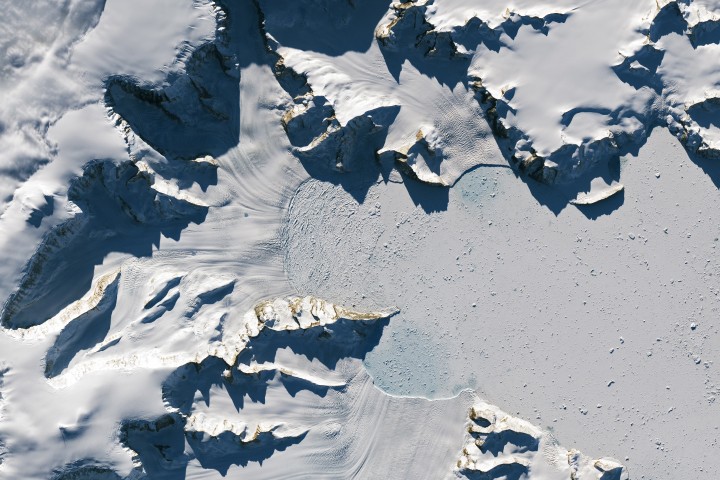
NASA satellite data reveals that Hektoria Glacier in Antarctica has undergone a dramatic retreat, losing massive quantities of ice at accelerating rates. Scientists analyzing imagery from Earth observation satellites tracked the glacier's collapse across multiple years, documenting one of the most severe ice loss events in the Antarctic Peninsula region.
The glacier's rapid deterioration stems from warming ocean temperatures destabilizing the ice shelf that normally anchors it to bedrock. As warmer water penetrates beneath the floating ice, it erodes the glacier's base faster than accumulation can replace it. This process, known as basal melting, triggers a feedback loop where thinning ice shelves lose their structural integrity and fracture into icebergs.
Hektoria Glacier's retreat holds implications beyond Antarctica. The glacier feeds into the Filchner-Ronne Ice Shelf system, one of Earth's largest floating ice masses. Scientists worry that continued destabilization of Antarctic ice shelves could eventually threaten the stability of the West Antarctic Ice Sheet itself, which contains enough ice to raise global sea levels by roughly 3.3 meters if fully melted.
The satellite data proving crucial comes from NASA's Earth Observing System, which provides consistent, high-resolution monitoring of polar regions that ground surveys cannot achieve. This remote sensing capability allows researchers to detect structural changes in glaciers and quantify ice loss with precision impossible before the satellite era.
Understanding Hektoria's behavior informs climate models predicting how Antarctic ice will respond to continued warming. The retreat demonstrates that major ice sheets respond to climate change far faster than many earlier models suggested, challenging assumptions about future sea level rise timelines.
WHY IT MATTERS: Antarctica's fastest-retreating glaciers signal how rapidly ocean warming translates to catastrophic ice loss, directly affecting sea level predictions for coastal populations worldwide.