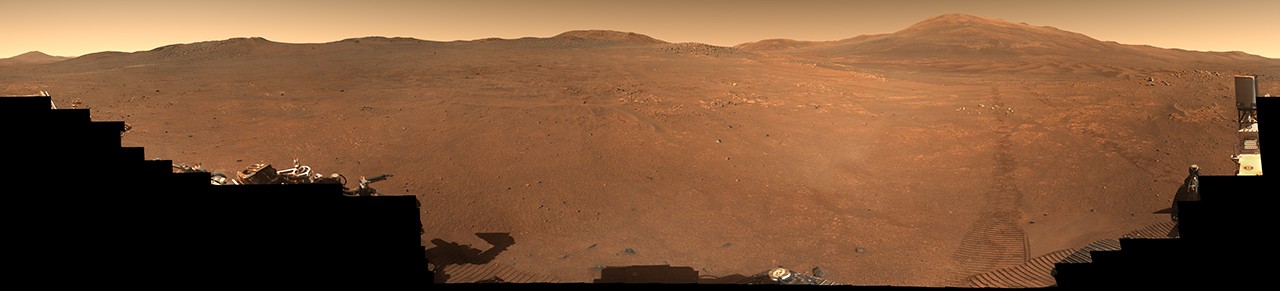
NASA's Perseverance rover captured a 360-degree panorama of "Crocodile Bridge," a region on the rim of Jezero Crater, using its Mastcam-Z camera system. The rover assembled the panorama from 980 images, with 971 frames captured on sol 1,717 (December 18, 2025). Nine additional images completed the composite.
Perseverance has been exploring Jezero Crater since its February 2021 landing. The rover's primary mission focuses on detecting signs of ancient microbial life and collecting rock samples for eventual return to Earth via NASA's Mars Sample Return campaign. The Mastcam-Z system serves dual purposes: it provides high-resolution imagery for geological analysis and helps the rover's team plan safe traversal routes across Martian terrain.
This panorama offers scientists detailed topography and geological context of the rover's current location. Studying rock formations and surface features at Crocodile Bridge helps the team understand Jezero's history as a former river delta, a prime location for discovering biosignatures in ancient sediment. Each image contributes data about mineral composition, erosion patterns, and layering that reveals Mars' past habitability.
Perseverance has already exceeded expectations. The rover collected dozens of core samples, including a rock that showed evidence of potentially habitable conditions billions of years ago. Its Ingenuity helicopter companion conducted over 70 flights before losing contact in late 2024, fundamentally changing how NASA approaches aerial reconnaissance on other worlds.
The 360-degree panorama exemplifies how rover cameras function as scientific instruments rather than mere documentation tools. Mastcam-Z's zoom capability and dual-lens design enable researchers to examine distant geological features and nearby surface details from a single location. These observations guide sample collection decisions and help prioritize future exploration targets.
With