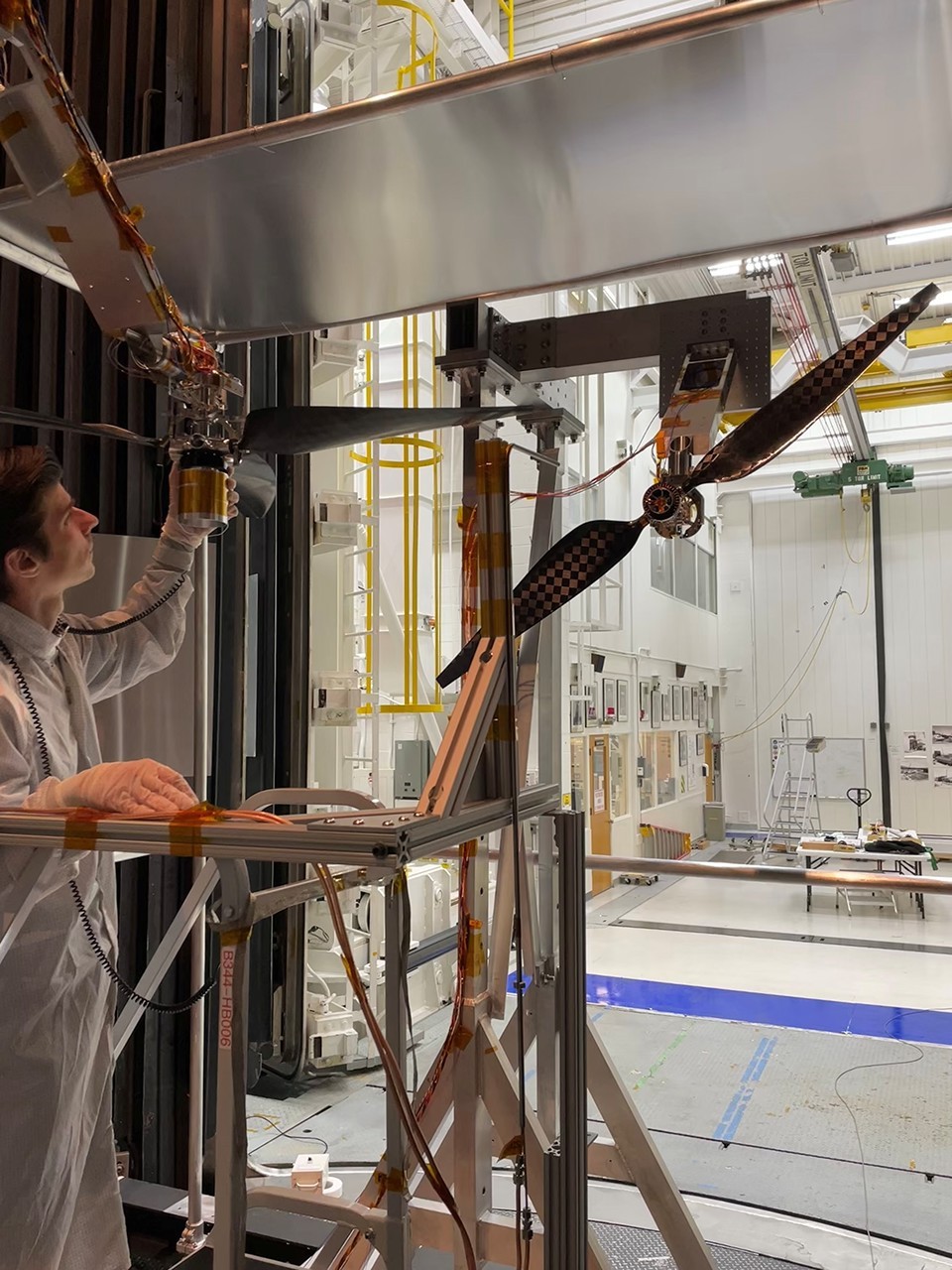
NASA engineers are pushing Mars helicopter technology toward faster flight by testing next-generation rotor blades in extreme conditions. Jaakko Karras and his team at the Jet Propulsion Laboratory ran supersonic speed tests on a three-bladed rotor design inside the 25-Foot Space Simulator in November 2025, simulating the thin Martian atmosphere where air density runs just 1 percent of Earth's sea level.
The successor to the Ingenuity helicopter, which exceeded all expectations during its two-year Mars mission, faces a core engineering problem. Thinner air demands faster rotor speeds to generate lift. Engineers pushed the new blades to supersonic velocities, a threshold Ingenuity's rotors never reached. A two-bladed rotor positioned vertically created artificial headwind during tests, allowing researchers to isolate performance data for the three-blade configuration.
This work directly supports NASA's strategy for expanded Mars exploration. Future rovers will need aerial support for reconnaissance, sample collection assistance, and hazard detection across terrain rovers cannot easily traverse. Faster rotors mean helicopters can cover greater distances and operate in dustier conditions. The test data informs design decisions on blade geometry, materials, and stress tolerances.
The Ingenuity achievement fundamentally changed how NASA approaches Mars mobility. The small rotorcraft flew 72 flights across nearly three years, proving that controlled flight works on another planet despite atmospheric challenges. Its successors must operate with greater reliability and capability.
JPL's testing regimen validates the rotor design before hardware reaches Mars. By operating these blades at supersonic speeds in a controlled environment, engineers confirm structural integrity and predict real-world performance. The 25-Foot Space Simulator reproduces Martian atmospheric conditions with precision unavailable anywhere else.
This next-generation helicopter represents a stepping stone toward sustained aerial operations on Mars.