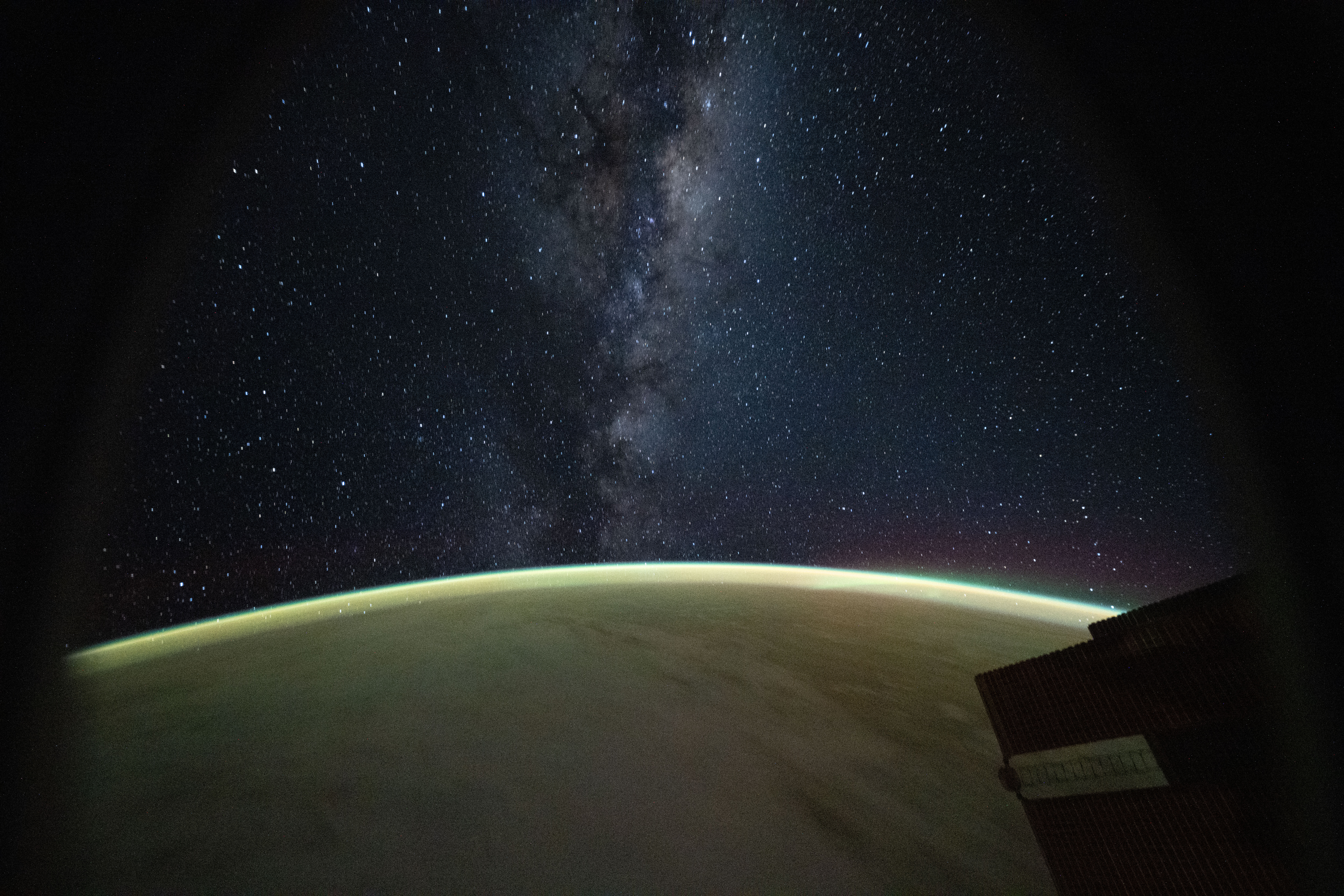
Chris Williams, a NASA astronaut aboard the International Space Station, photographed the Milky Way rising above Earth's airglow on April 13, 2026. The image captures a rare perspective of our galactic home framed against the planet's upper atmosphere.
Airglow results from a fundamental process in Earth's upper atmosphere. Sunlight energizes atoms and molecules in the thermosphere, lifting them to excited states. These particles then release that excess energy as photons, creating a faint but pervasive luminescence that bathes the night sky in soft color.
From ground level, airglow remains nearly invisible to human eyes, drowned out by city lights and obscured by the atmosphere itself. From the ISS orbital altitude of 250 miles, the vantage point transforms airglow into a vivid phenomenon. The glow forms a thin, glowing band separating the blackness of space from Earth's darker landmasses below. Against this backdrop, the Milky Way's spiral structure becomes starkly visible.
Williams captured this image while aboard a SpaceX Dragon spacecraft docked to the station. The photograph demonstrates the station's unique value for documenting Earth's atmosphere and celestial phenomena simultaneously. Astronauts aboard the ISS regularly conduct observations impossible from ground-based telescopes or satellites designed for nadir-pointing measurements.
This type of imagery serves both scientific and inspirational purposes. Researchers use airglow observations to study upper atmospheric dynamics, composition, and the complex interactions between Earth's thermosphere and the solar wind. The data contributes to models predicting atmospheric behavior during geomagnetic storms and supports ionospheric research.
The image also represents the human dimension of space exploration. Direct observation and documentation by trained astronauts adds irreplaceable context that automated instruments cannot provide. Williams' photograph merges technical documentation with perspective, illustrating how the