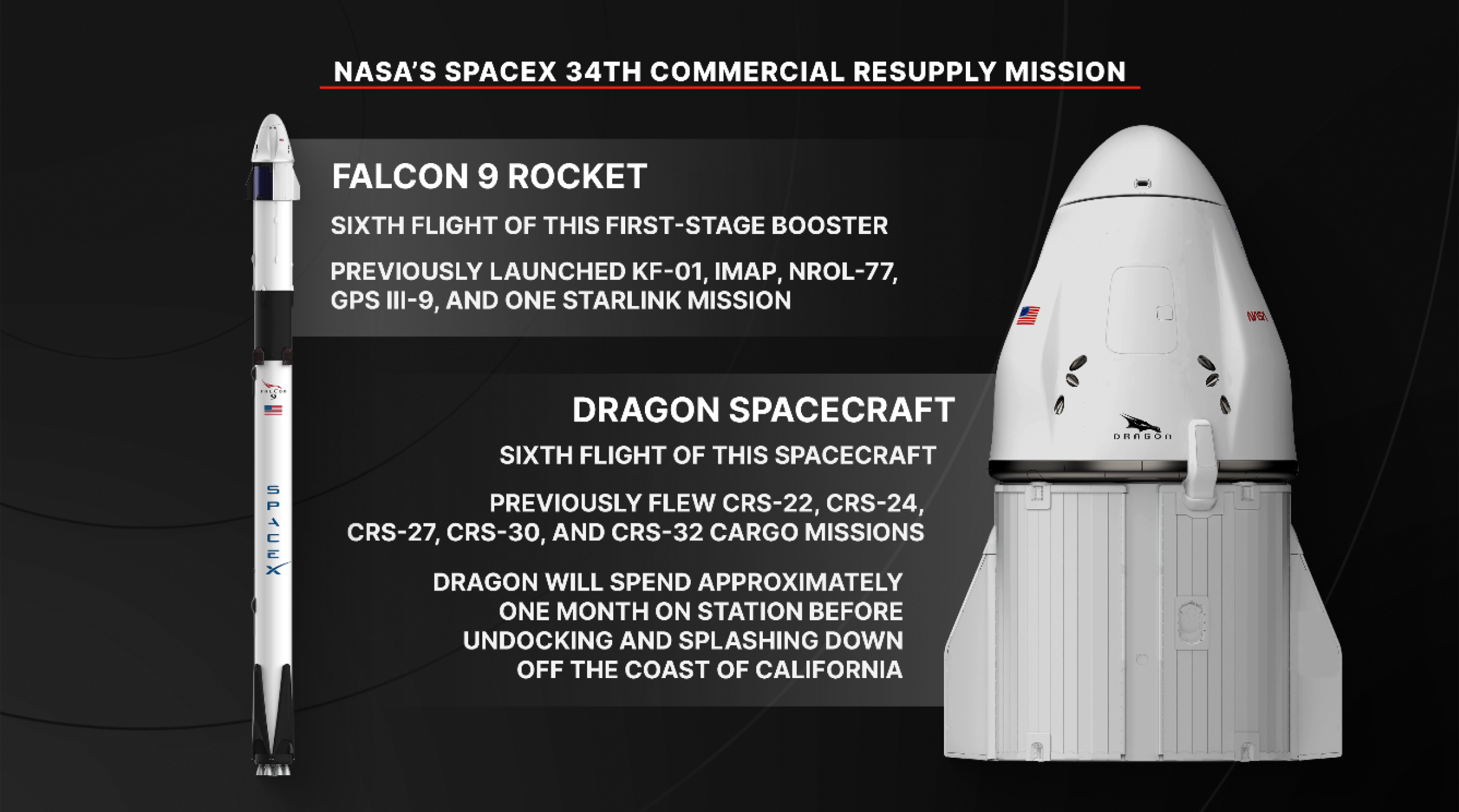
SpaceX and NASA plan a mid-May launch of the company's 34th Commercial Resupply Services mission to the International Space Station. A Dragon spacecraft carrying approximately 6,500 pounds of cargo will ascend atop a Falcon 9 rocket from Cape Canaveral Space Force Station's Launch Complex 40 in Florida.
The Dragon capsule will complete an autonomous docking sequence at the station's forward port upon arrival. This cargo delivery represents another iteration of the operational resupply cadence that sustains the orbiting laboratory. SpaceX has executed dozens of these missions under its Commercial Resupply Services contract with NASA, ferrying experiments, equipment, and consumables essential to crew operations and ongoing research.
The mission underscores the dependence of ISS operations on commercial cargo providers. Since the retirement of the Space Shuttle in 2011, NASA has relied on SpaceX Dragon and Northrop Grumman Cygnus spacecraft to maintain station inventory and enable continuous scientific investigations across microgravity research programs.
Dragon vehicles possess a unique capability among cargo spacecraft: they return to Earth with experiment results and hardware. This retrieval capacity allows researchers to recover biological samples, materials science specimens, and data that cannot be transmitted digitally. The spacecraft itself burns up during reentry, limiting reusability for cargo variants, though SpaceX develops crewed Crew Dragon capsules specifically engineered for astronaut transport and landing recovery.
The approximately 6,500-pound payload reflects routine resupply requirements, though specific experiments aboard this mission remain under standard NASA manifest disclosure procedures. ISS crews rotate every six months, requiring consistent delivery of food, water recycling equipment, spare parts, and scientific apparatus to maintain the station's research tempo.
This mission continues a proven operational rhythm. SpaceX has delivered 33 prior cargo missions to the ISS, establishing the