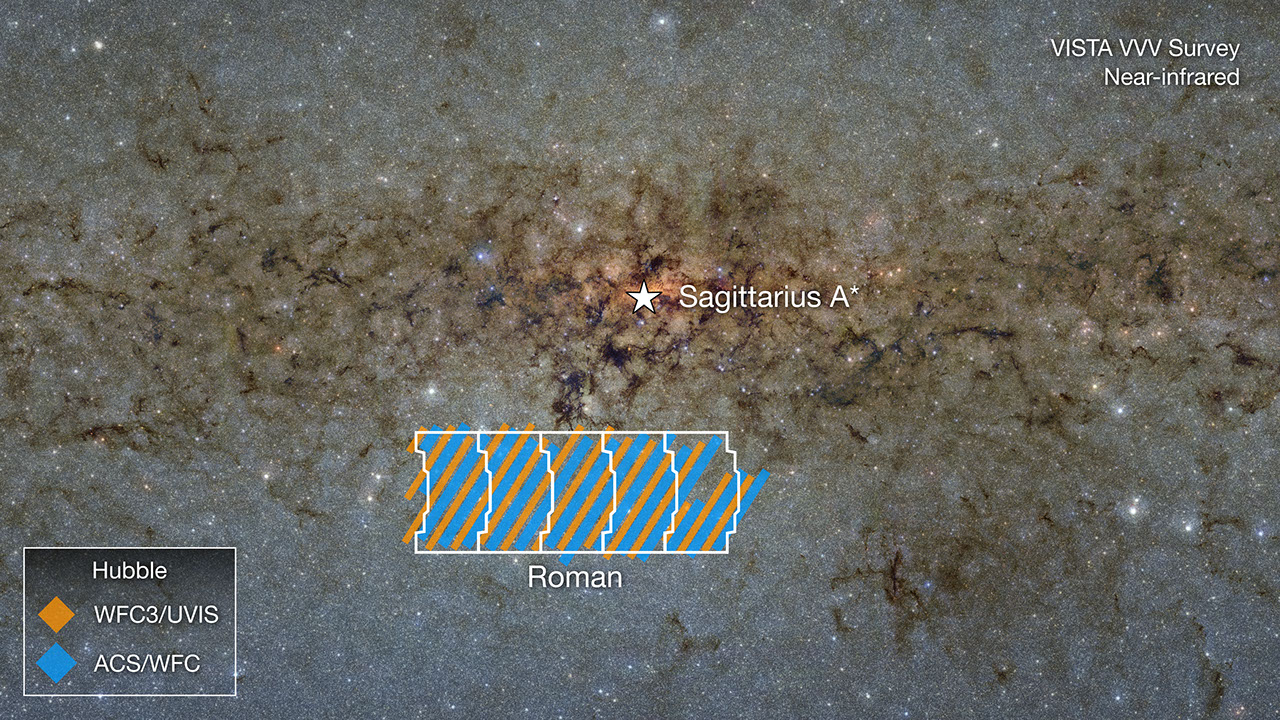
NASA's Hubble Space Telescope is laying groundwork for the Nancy Grace Roman Space Telescope's future observations of the Milky Way's galactic bulge, the densely packed region surrounding our galaxy's center. Hubble has conducted a comprehensive survey of this stellar-rich zone, cataloging millions of stars and objects that Roman will study with unprecedented infrared sensitivity.
The galactic bulge presents a frontier for understanding galactic structure. Packed with stars, planets, and free-floating objects in close proximity, this region challenges traditional observation methods. Ground-based telescopes struggle with atmospheric distortion. Even Hubble and the James Webb Space Telescope encounter limitations when observing such crowded stellar fields.
Roman will change this dynamic. Scheduled to launch in the coming years, Roman's infrared capabilities will penetrate dust clouds that obscure visible light observations. The telescope's wide field of view and sensitivity will reveal populations of stars and planetary objects invisible to current instruments. Roman's observations will map stellar populations, track planetary motions, and detect objects ranging from brown dwarfs to rogue planets.
The Hubble survey serves as a reference frame. By establishing precise positions and brightness measurements of millions of objects now, Hubble creates a baseline. Roman can then measure how these objects move and evolve over time. This temporal dimension reveals dynamics of galactic structure, stellar interactions, and the gravitational landscape near the galactic center.
The galactic bulge study connects to broader exploration goals. Understanding our galaxy's central region informs theories about galactic formation and evolution. The distribution of stars and objects reveals how gravity shaped the Milky Way over billions of years. These observations also contextualize discoveries of exoplanets and stellar systems within galactic structure.
Roman represents a leap forward in infrared astronomy. While Hubble and Webb excel at specific capabilities, Roman combines wide-field imaging with infra