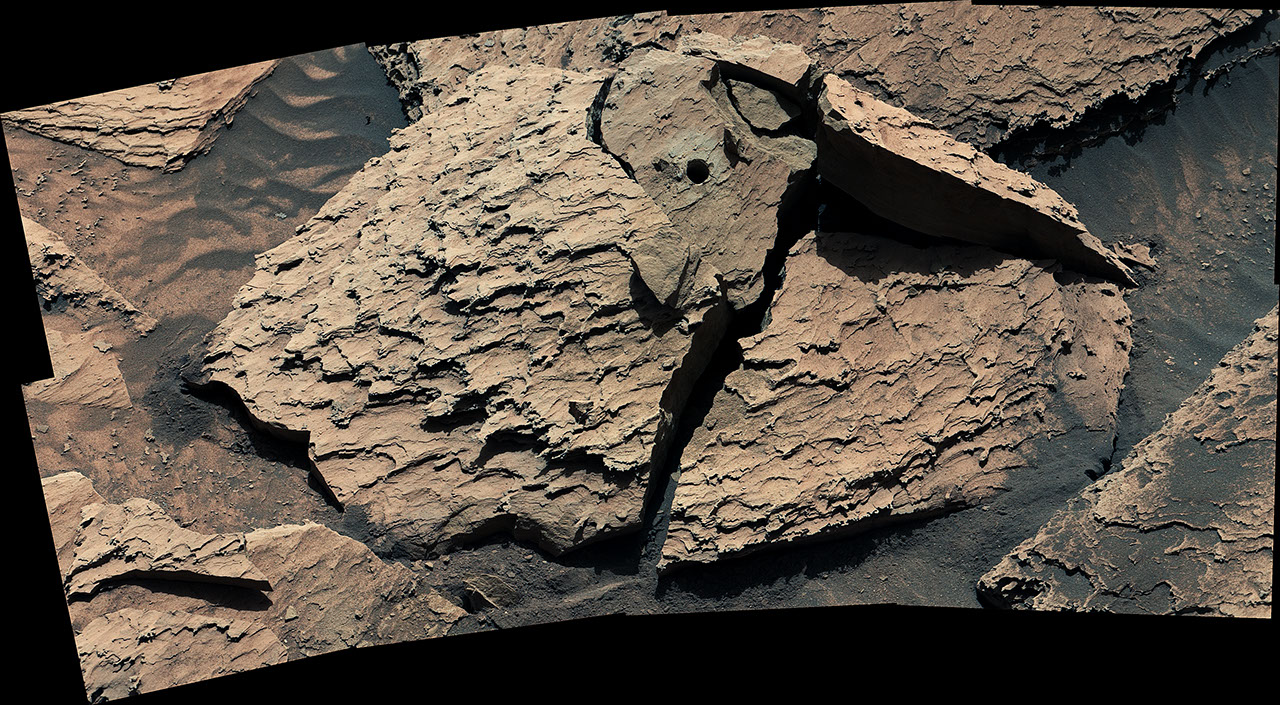
NASA's Curiosity rover encountered a drilling obstacle on Mars when a rock became lodged on the rover's sample collection drill bit on April 25, 2026. Engineers at NASA's Jet Propulsion Laboratory spent several days developing a solution to dislodge the rock, nicknamed "Atacama," from the drill mechanism mounted on Curiosity's robotic arm.
The rover's Mast Camera captured detailed images of the stuck rock on May 6, 2026, marking sol 4,877 of the mission. These images allowed engineers to assess the obstruction and plan removal procedures. Curiosity's drill represents a critical tool for the rover's core science mission: extracting subsurface samples from Martian rocks to analyze for signs of ancient habitability and organic compounds.
This obstacle underscores the engineering challenges rover teams face operating remotely across 140 million miles of space. Curiosity communicates with Earth only through intermittent windows, requiring engineers to diagnose problems and devise solutions with significant communication delays. Each command sent to Mars takes between five and twenty minutes to arrive, depending on planetary positions.
The incident did not halt Curiosity's broader operations on Mars. Since landing in Gale Crater in 2012, the rover has continuously explored the region, drilling into multiple rock formations and climbing the slopes of Mount Sharp, a central peak within the crater. The mission has provided unprecedented geological data about Mars' past climate and atmospheric conditions.
Curiosity's persistence through mechanical challenges reflects the rover's robust design and the JPL team's problem-solving capability. The rover was originally planned for a two-year mission but has far exceeded expectations, delivering over a decade of continuous scientific data. Engineers regularly adapt procedures to keep the aging rover operational as components experience wear from Martian dust and temperature extremes.
The rock incident demonstrates how even routine sample collection on Mars demands