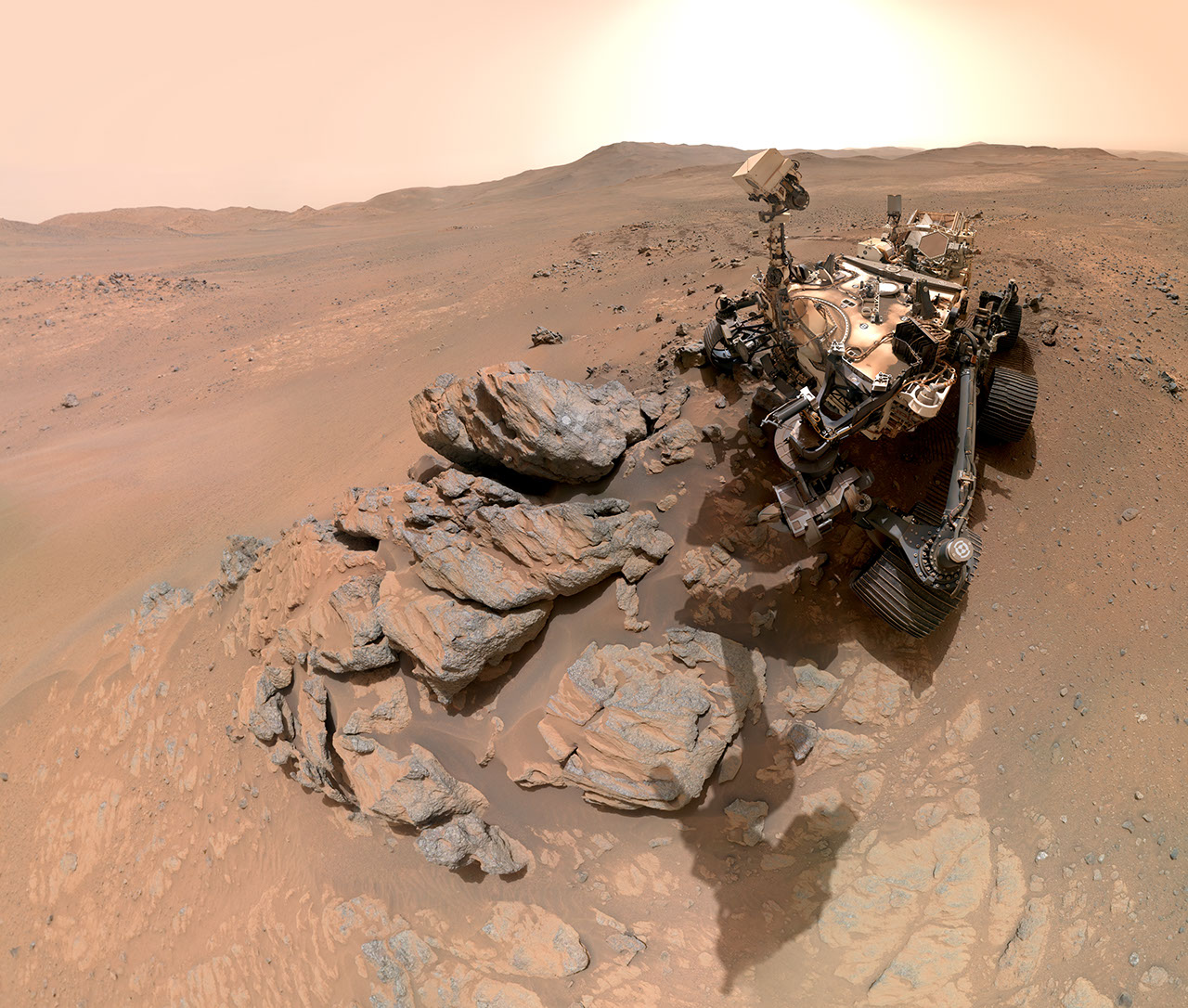
NASA's Perseverance rover captured a selfie on sol 1,797 of its Mars mission, marking the rover's deepest westward penetration beyond Jezero Crater. The image, stitched together from 61 individual photographs, shows Perseverance positioned near the "Arethusa" rocky outcrop after the rover abraded its surface to expose fresh material for analysis.
The westward progression extends Perseverance's scientific reach into unexplored terrain within and beyond the 45-kilometer-wide impact basin. The abrasion patch, created by the rover's rotating brush tool, reveals unweathered rock layers that reveal compositional information invisible on oxidized surfaces. This technique has become routine for Perseverance's geology work since landing in February 2021.
The Arethusa outcrop presents geological targets that advance the mission's primary objective: searching for biosignatures and characterizing Jezero's ancient habitability. The rover's instruments, including the PIXL spectrometer and SHERLOC Raman spectrometer mounted on its robotic arm, analyze elemental and molecular composition of freshly exposed surfaces. Data collected at these western locations helps researchers understand how water, minerals, and chemical conditions evolved across the crater floor.
Perseverance operates as a mobile laboratory designed to collect samples for eventual return to Earth via NASA's Mars Sample Return campaign. Each location visited and each abraded surface studied contributes geological context for understanding which samples warrant the expense of sample caching and future retrieval missions.
The rover's ability to travel while conducting sophisticated science distinguishes it from stationary landers. At sol 1,797, Perseverance continues delivering the data that transforms Mars from a geologically static world into a dynamic system with a potentially habitable past. The westward push demonstrates the rover's sustained capability to explore terrain that orbital imagery alone