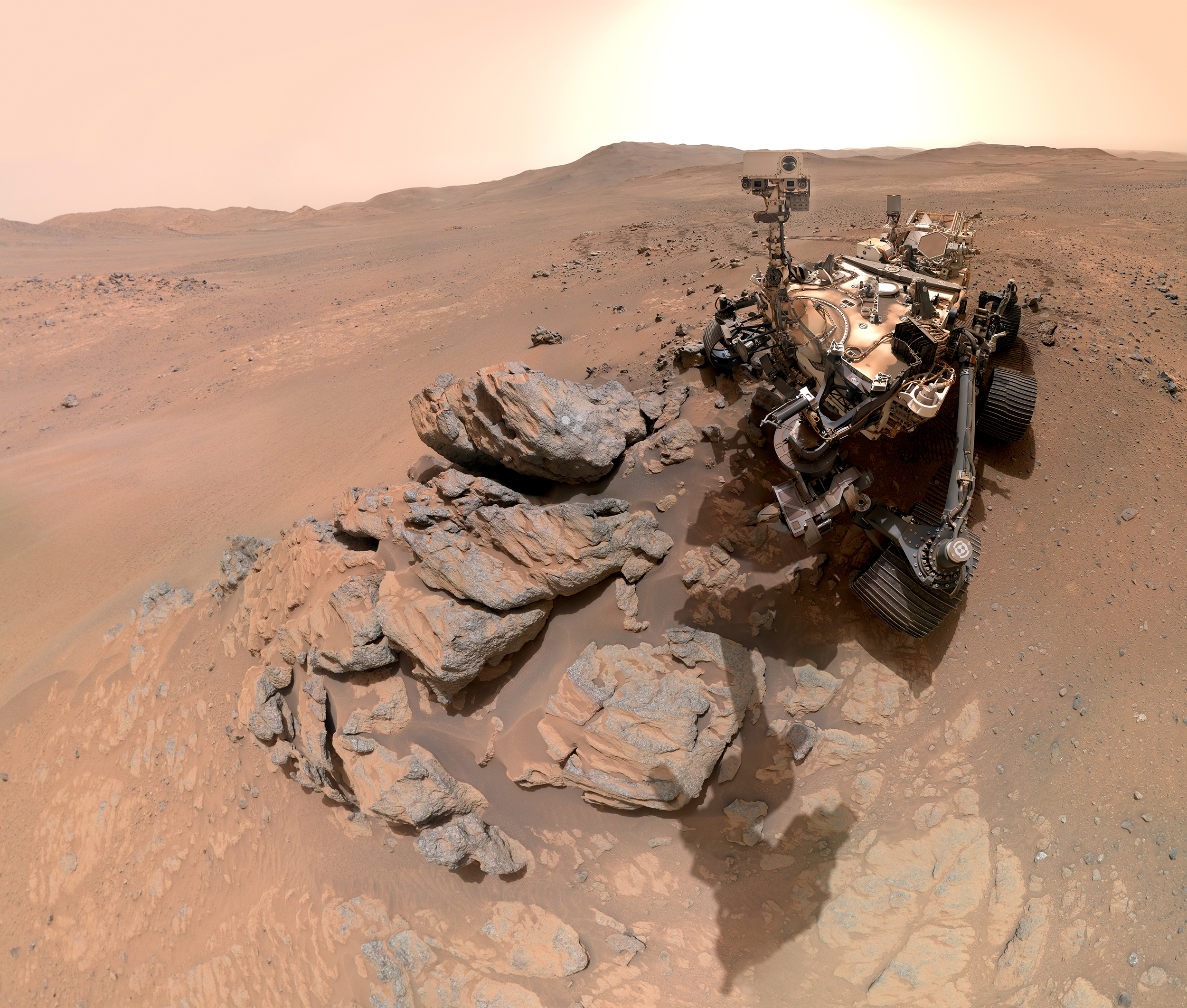
NASA's Perseverance rover has captured a striking self-portrait at "Lac de Charmes," a location in Jezero Crater that reveals the rover's relentless exploration of Mars' geological history. The mosaic, composed of 61 individual images, depicts Perseverance positioned beside a freshly abraded rock outcrop, its drill and abrasion tool visible in the foreground against a vast expanse of ancient Martian terrain.
The rover's mast camera, mounted atop its rotating turret, created this detailed self-image while the rover simultaneously conducted direct analysis of the exposed rock surface. This geological investigation targets pristine material beneath Mars' weathered surface layer, providing uncontaminated samples for the rover's onboard spectrometers and other instruments. The western rim of Jezero Crater stretches across the background, offering context for the rover's position within a basin that once hosted a flowing river delta billions of years ago.
Perseverance operates as both geologist and photographer, balancing exploration objectives with documentation. The rover has now logged over two years of operation since its February 2021 landing, systematically traversing Jezero's floor and climbing toward the crater's central peak. Each self-portrait serves as both a technical achievement and a record of the rover's progress through increasingly rugged terrain.
The "Lac de Charmes" site represents one of many carefully selected study areas where Perseverance's science instruments have detected evidence of past water-rock interactions. These observations feed into NASA's broader strategy for Mars exploration, building understanding of the planet's past habitability while paving the way for eventual human missions. The rover's ability to document its own work demonstrates the sophisticated autonomous systems that allow rovers to operate independently across millions of miles while transmitting results back to Earth.