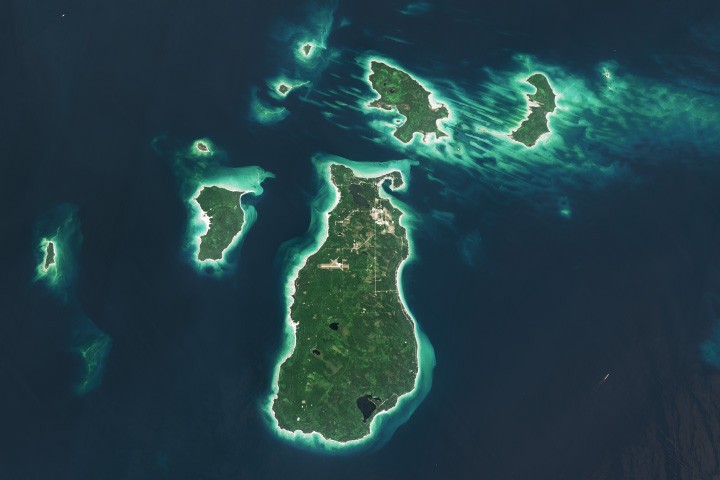
NASA has identified Beaver Island as a striking geographic feature within Lake Michigan's northern archipelago. The island sits among a chain of verdant landmasses that form one of North America's most visually distinctive freshwater ecosystems.
Beaver Island spans roughly 56 square miles and hosts dense forests, wetlands, and shoreline habitats that support diverse wildlife populations. The island's emerald appearance stems from its thick vegetation coverage and its position within the Great Lakes system, where it experiences the moderating climate effects of one of Earth's largest freshwater bodies.
From orbital vantage points, NASA's Earth observation satellites capture the archipelago's complex geometry and ecological patterns. The imaging reveals how water, vegetation, and geological formations interact across the northern Lake Michigan region. These observations help scientists monitor changes in forest health, shoreline erosion, and water quality across the Great Lakes.
The island holds historical significance as well. Beaver Island served as a fur trading hub during the 18th and 19th centuries and later became home to a Latter-day Saint community. Today it operates as a popular destination for recreational boating and fishing, with a year-round population of roughly 4,400 residents who depend on seasonal ferry service from the mainland.
NASA's remote sensing capabilities document how the archipelago functions as an integrated environmental system. The satellites track vegetation patterns, water temperature variations, and seasonal changes that affect both the natural ecosystem and human communities dependent on the island's resources.
Earth observation data from NASA missions provides baseline information for understanding how climate patterns influence freshwater island ecosystems. The archipelago serves as a natural laboratory for studying how Great Lakes geography shapes regional weather, biodiversity, and human settlement patterns. Such information guides conservation efforts and helps coastal communities prepare for environmental shifts driven by changing climate conditions.