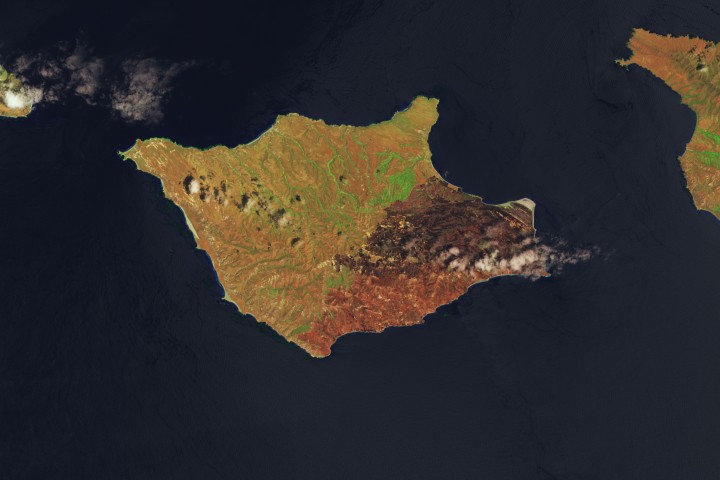
A wildfire consumed roughly one-third of Santa Rosa Island, the second largest of California's Channel Islands, burning through grassland, coastal sage scrub, and chaparral vegetation. NASA tracked the fire's progression and impact across the remote island located off the coast of Santa Barbara County.
Santa Rosa Island spans approximately 15 square miles and supports a unique ecosystem found nowhere else on Earth. The island hosts endemic plant and animal species that evolved in isolation for millennia, making the burned area a significant loss for conservation. Channel Islands National Park manages the island as a protected reserve.
The fire's extent became visible through NASA satellite imagery, which documented the charred landscape in detail. Remote sensing data from orbital platforms allows scientists to assess fire severity, track vegetation loss, and monitor post-fire recovery without requiring direct ground access to the rugged terrain.
Wildfires in the Channel Islands present distinct challenges. The islands' isolated location and sparse human infrastructure limit firefighting response capabilities. Once vegetation burns, the exposed soil becomes vulnerable to erosion during winter rains, potentially degrading habitat for the island's rare species. Wind patterns around the islands can also accelerate fire spread rapidly across the landscape.
Recovery timelines for the island's chaparral and sage scrub communities typically span decades. Some endemic plants may not regenerate successfully if fire severity exceeded their natural tolerance levels. Scientists use satellite monitoring to track vegetation regrowth and assess whether the ecosystem follows its historical recovery patterns or shifts into a different ecological state.
NASA's Earth Observation missions provide ongoing documentation of these environmental changes. Data from instruments aboard satellites helps land managers at Channel Islands National Park develop restoration strategies and understand how climate change and shifting fire regimes affect island ecosystems. The island fire serves as a natural experiment in post-fire recovery for one of California's most ecologically distinct landscapes.