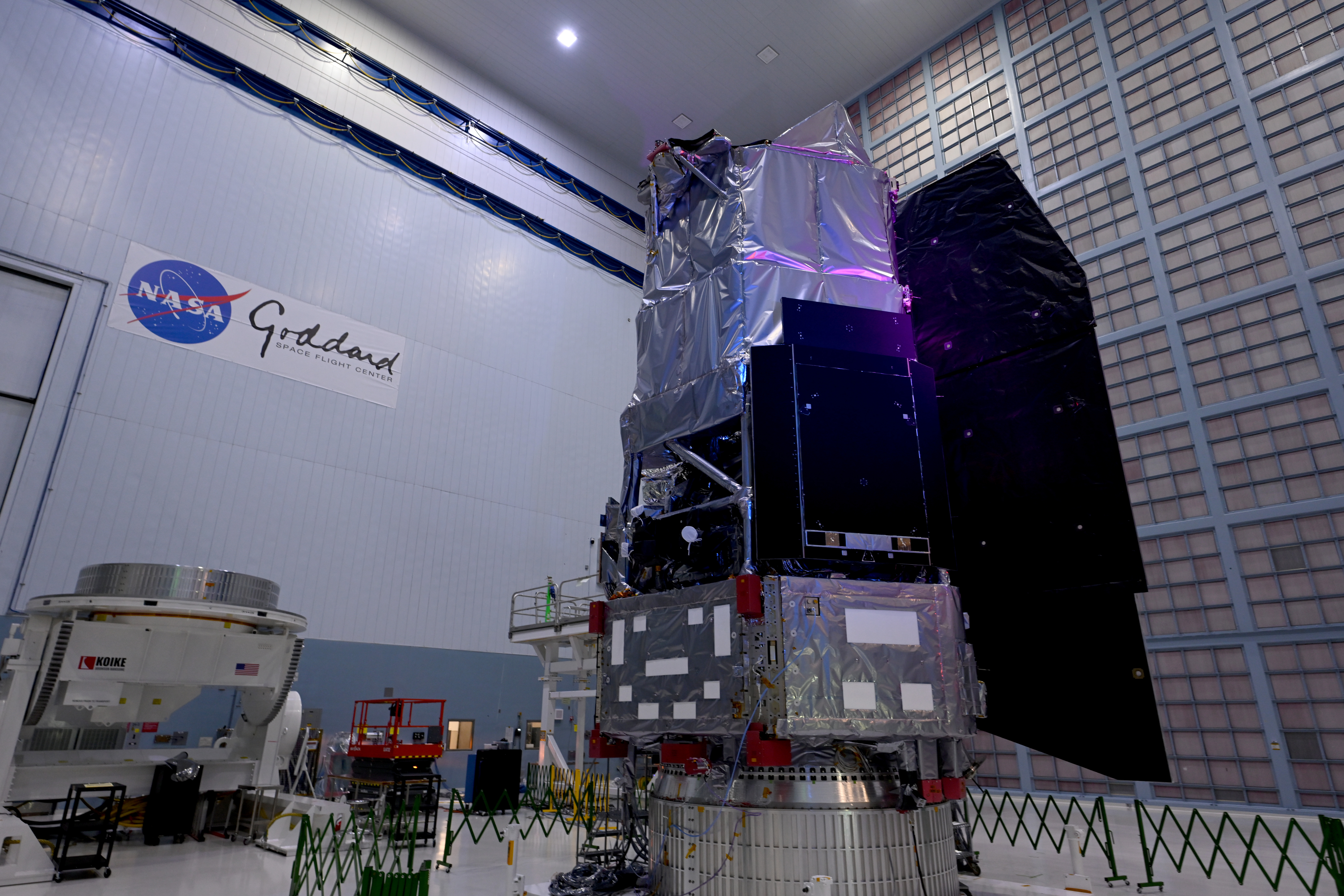
NASA's Nancy Grace Roman Space Telescope will arrive at Kennedy Space Center in Florida aboard the Pegasus barge in the coming weeks, completing its journey from NASA's Goddard Space Flight Center in Maryland. The agency has opened registration for credentialed media to document the arrival of the observatory, which represents a major milestone for one of NASA's most ambitious astrophysics missions.
Roman, named after the pioneering NASA astrophysicist Nancy Grace Roman, will conduct wide-field infrared imaging and spectroscopy of the universe. The telescope aims to answer fundamental questions about dark energy, exoplanet detection, and the large-scale structure of the cosmos. Its 2.4-meter mirror and advanced infrared instruments will enable observations across wavelengths that complement and extend the capabilities of the James Webb Space Telescope.
The completion of construction, assembly, and testing at Goddard Space Flight Center marks the end of a rigorous development phase. Kennedy Space Center hosts the hardware needed for final integration with the launch vehicle and conducts the final pre-flight preparations. The observatory's arrival in Florida signals the transition toward launch readiness, bringing the mission closer to its scheduled deployment in the mid-2020s.
Roman's infrared sensitivity will enable it to peer through dust-obscured regions of space, revealing star formation and galactic evolution across cosmic history. The mission will search for potentially habitable exoplanets and measure the expansion history of the universe with unprecedented precision. These observations will test Einstein's theory of general relativity on cosmic scales and probe the nature of dark energy, which drives the universe's accelerating expansion.
The Pegasus barge transport represents careful logistics for an observatory containing sensitive optics and electronics. Kennedy's infrastructure supports final assembly, thermal vacuum testing, and integration with the launch vehicle before Roman lifts off toward its destination at the Sun-Earth L2 Lagrange point,