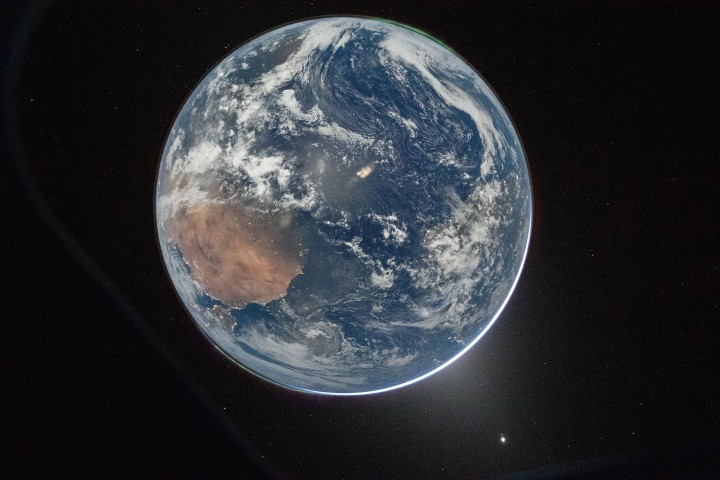
Astronauts aboard NASA's Artemis II mission captured a striking photograph of Earth illuminated by moonlight during their journey to lunar orbit. The image, taken from the spacecraft as it traveled outbound, shows our planet suspended against the darkness of space with the Moon's reflected sunlight casting an ethereal glow across Earth's surface.
The photograph represents more than aesthetic value. It documents a perspective achieved only during lunar missions, when spacecraft venture far enough from Earth to capture both our world and the Moon in a single frame, with the Sun positioned behind the observer. This vantage point remains rare in human spaceflight. Only Apollo astronauts achieved similar views during the 1960s and 1970s. Artemis II marks the first crewed voyage to lunar space since Apollo 17 in 1972, making this image part of NASA's broader effort to return humans to the Moon under the Artemis program.
The Artemis II mission, launched in November 2022, carried a four-person crew around the Moon without landing. The flight served as a crucial test of NASA's Space Launch System and Orion spacecraft before the Artemis III landing mission, scheduled for later in the decade. Photographer details remain unconfirmed, though any of the four crew members could have captured the shot.
Such imagery carries scientific and cultural weight. Photographs from space reshape how humanity perceives its place in the cosmos. The "Earthrise" image from Apollo 8 in 1968 transformed environmental consciousness. This Artemis II photograph continues that tradition, rendering Earth as a discrete object in space, bathed in reflected lunar light rather than direct sunlight. The image reinforces Earth's isolation and fragility while celebrating humanity's expanding reach beyond our home planet. These perspectives, captured during actual exploration missions, prove invaluable for both scientific documentation and the public engagement that sustains long