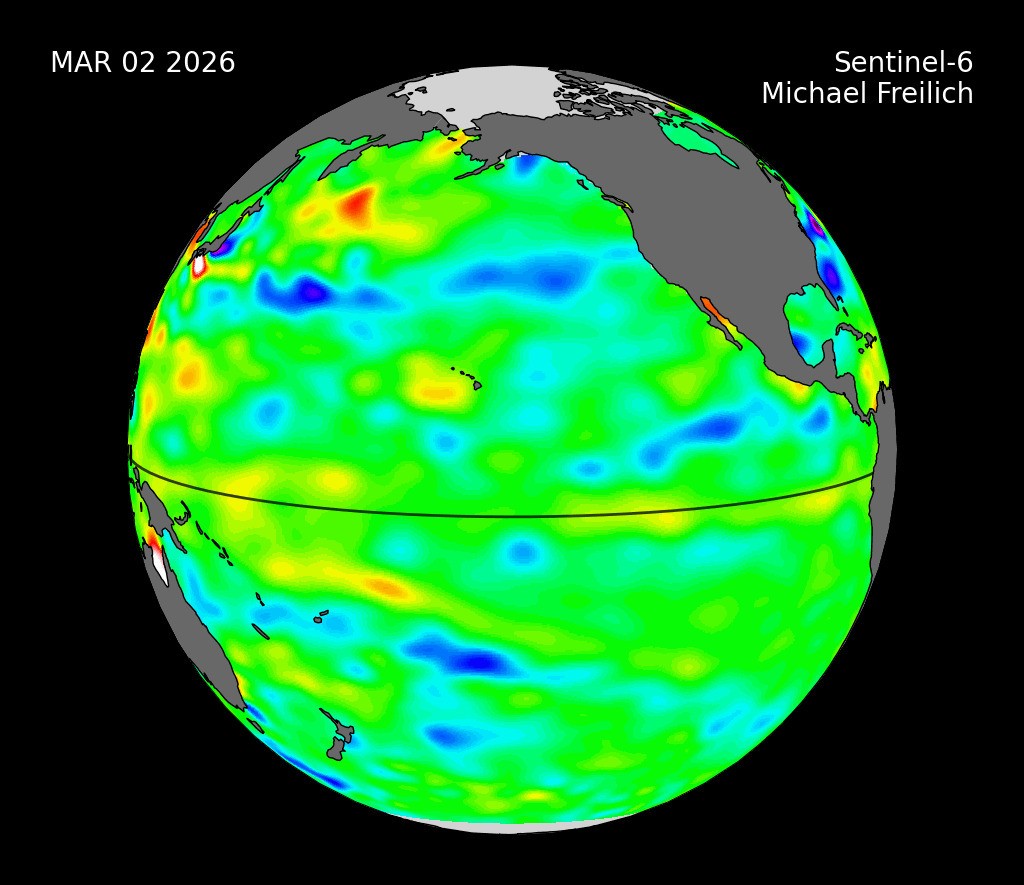
A warm Kelvin wave crossing the Pacific Ocean has triggered El Niño precursor conditions, according to sea level measurements from the Sentinel-6 Michael Freilich satellite. Between March and May 2026, the international spacecraft observed elevated water temperatures traveling eastward from the western Pacific toward South America's west coast, off Colombia, Ecuador, and Peru.
The Sentinel-6 Michael Freilich mission, a joint effort between NASA, the European Space Agency, and the European Organisation for the Exploitation of Meteorological Satellites, tracks ocean surface heights with centimeter-level precision. These measurements reveal subsurface temperature anomalies critical for understanding tropical climate patterns. Warm Kelvin waves form when anomalously warm water along the equator propagates eastward across the Pacific basin, typically taking three to six months to traverse the ocean.
This eastward movement represents a hallmark signature of developing El Niño conditions. When warm water reaches the coast of South America and suppresses the nutrient-rich upwelling that normally characterizes that region, global climate impacts cascade. El Niño disrupts precipitation patterns across the tropics and mid-latitudes, affecting agriculture, fisheries, and weather systems worldwide.
Sentinel-6 Michael Freilich operates as a continuity mission to decades of sea surface height data, maintaining critical observational records that began with TOPEX/Poseidon in 1992. The satellite carries a radar altimeter that measures the distance between the spacecraft and ocean surface, translating these measurements into precise height data. Combined with temperature profiles from other instruments, altimetry reveals the three-dimensional structure of ocean anomalies driving climate variability.
Early detection of warm Kelvin waves enables climate forecasters at institutions like NOAA's Climate Prediction Center to issue El Niño watches and warnings months in advance. This lead time