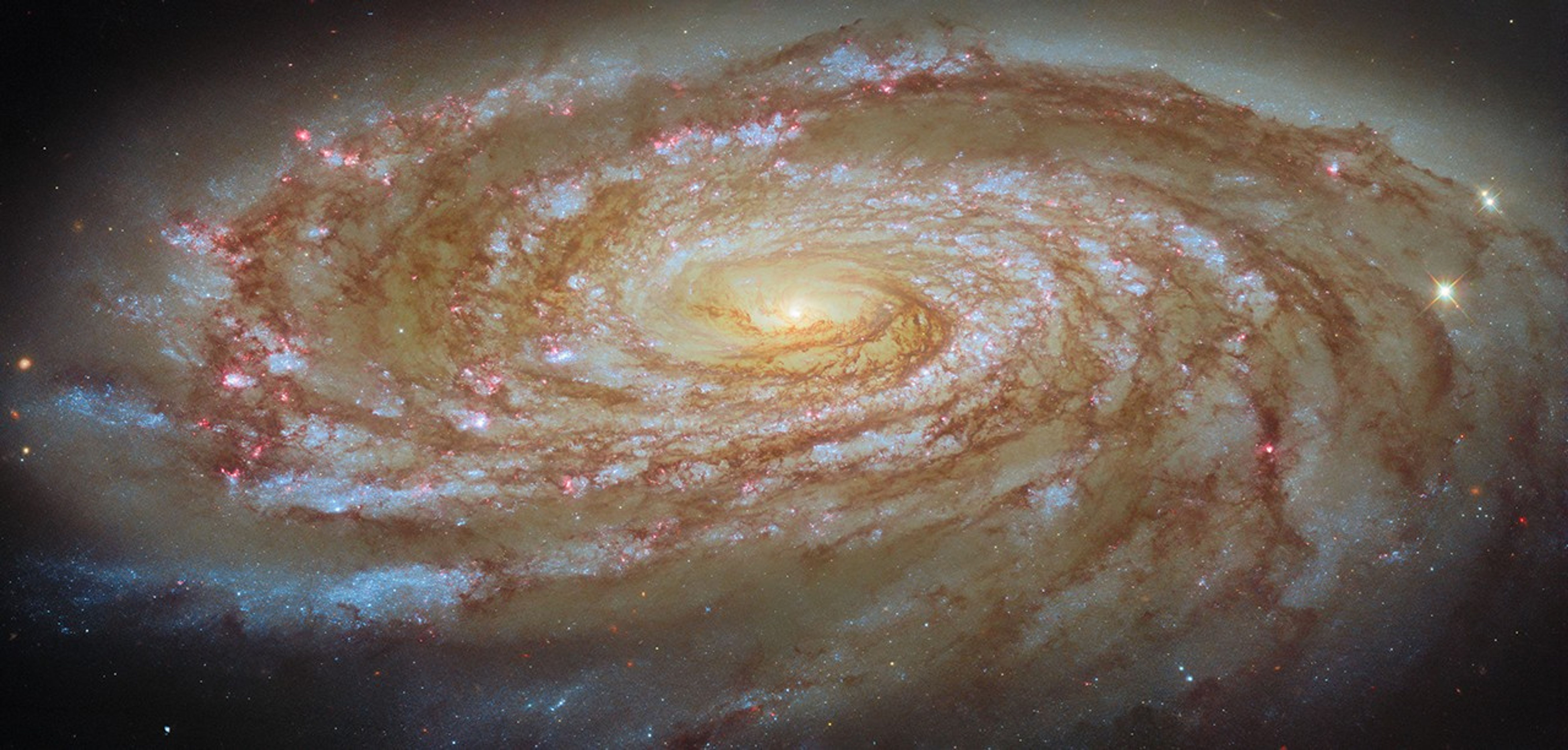
The Hubble Space Telescope has captured a striking image of Messier 88, an active spiral galaxy 63 million light-years distant in the constellation Coma Berenices. NASA and the European Space Agency released the observation on May 29, 2026, revealing M88 in the midst of a centuries-of-millions-year gravitational journey toward the center of the Virgo Cluster.
M88 qualifies as an active galaxy, meaning its core harbors a supermassive black hole that actively accretes material and radiates energy across the electromagnetic spectrum. The Hubble telescope's resolution captures the galaxy's elegant spiral structure in remarkable detail, showing dust lanes and star-forming regions that trace the galaxy's rotating disk.
The Virgo Cluster contains over 1,300 galaxies bound together by gravity, with M87 serving as the cluster's dominant elliptical galaxy. M88's infall toward this gravitational center occurs over timescales measured in hundreds of millions of years, a process that shapes galactic evolution within massive galaxy clusters. As M88 approaches the cluster's heart, gravitational interactions with other cluster members gradually alter its trajectory and structure.
This Hubble observation documents a critical phase in galactic dynamics. The image reveals how spiral structure persists even as M88 experiences the tidal forces of cluster membership. Active galactic nuclei like M88's emit jets and radiation powered by material spiraling into the central black hole, processes that astronomers continue studying to understand how black holes grow and influence their host galaxies.
The Hubble Space Telescope remains instrumental in mapping the universe's large-scale structure. Images of galaxies in transit through clusters like Virgo illuminate how gravity orchestrates cosmic architecture across billions of years. M88 exemplifies the dynamic nature of the cosmos, where no galaxy travels alone and every