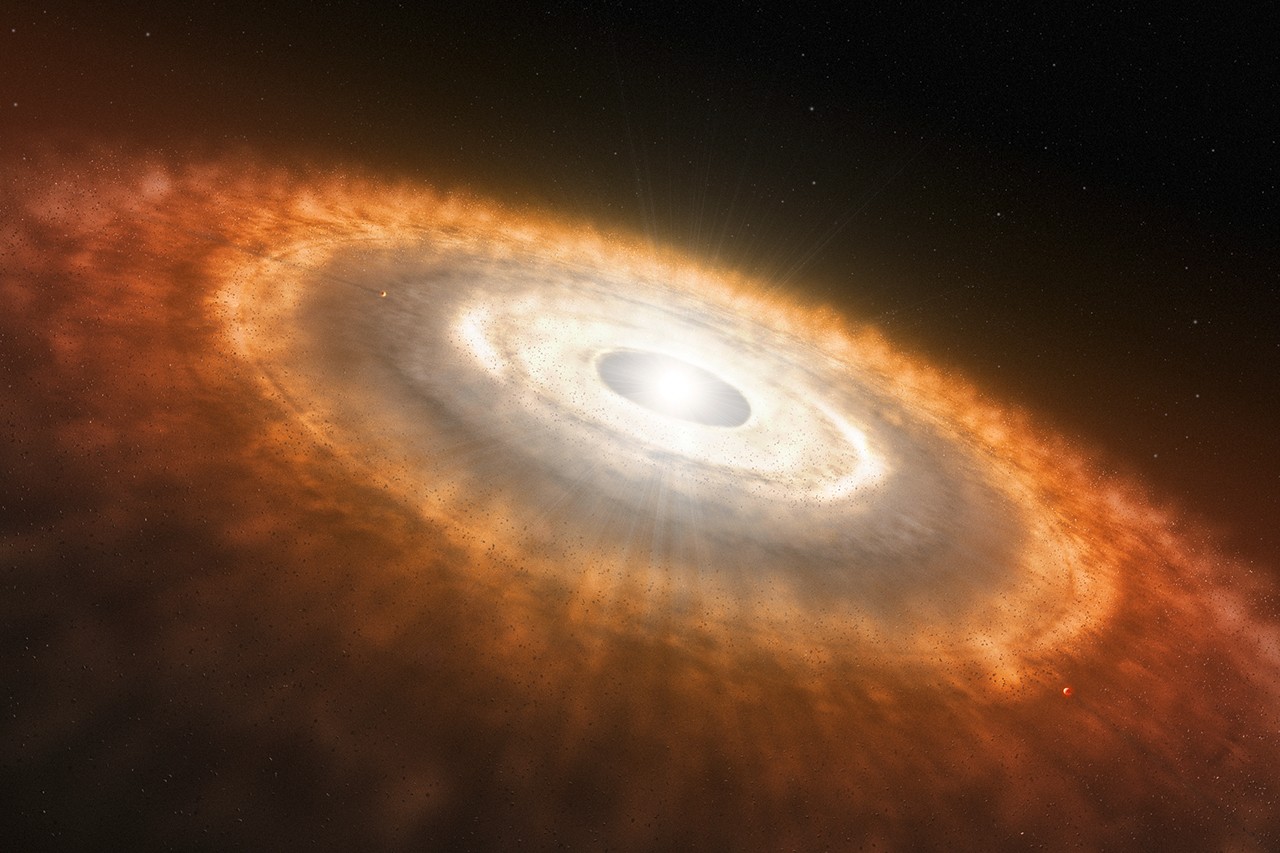
NASA-supported researchers have identified a new mechanism explaining how Earth acquired essential elements for habitability during the solar system's early formation. The study, published in Science Advances, traces the delivery of life-critical materials and proposes an expanded role for Jupiter in distributing these compounds throughout the young planetary system.
The research examines the chemical composition of meteorites and planetary materials to reconstruct how volatile and refractory elements reached the early Earth. Scientists focused on elements like carbon, nitrogen, and water that proved fundamental to biological chemistry. Previous models emphasized delivery through carbonaceous chondrite meteorites, but this work suggests additional pathways shaped planetary compositions during the first few million years of solar system evolution.
Jupiter emerges as a central player in this distribution system. The gas giant's gravitational influence didn't merely scatter asteroids randomly but actively channeled material-rich bodies toward the inner planets. As Jupiter migrated through the protoplanetary disk, it created orbital resonances that funneled volatile-rich planetesimals inward. This process allowed Earth to accumulate the chemical building blocks necessary for life while receiving sufficient energy and stability to retain them.
The findings reshape understanding of planetary formation physics. Rather than viewing the early solar system as a chaotic collision zone, the research reveals organized processes driven by planetary migration and orbital dynamics. Jupiter's mass and position functioned as a cosmic traffic director, steering material delivery with surprising precision.
This mechanism carries implications beyond Earth. It suggests exoplanetary systems with similar architecture could host Earth-like planets positioned to receive habitable-zone conditions and the chemical precursors for life. Researchers can now apply these insights when evaluating potentially habitable worlds around distant stars, particularly those orbiting within systems containing gas giants comparable to Jupiter.
Understanding these ancient chemical pathways connects planetary formation to habitability itself. The research demonstrates that life's emergence on Earth depended on specific gravitational choreography billions of