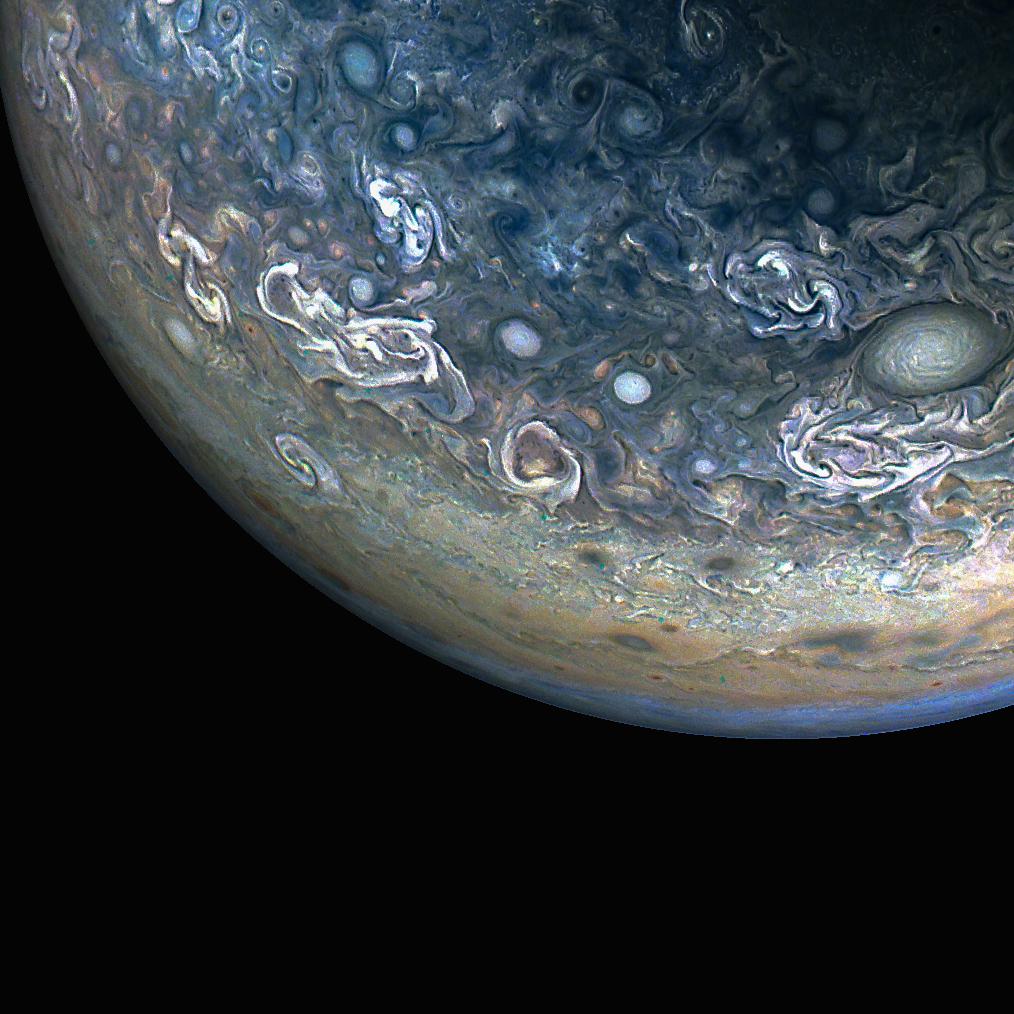
NASA's Juno spacecraft captured vivid imagery of Jupiter's northern hemisphere during its 61st close approach to the gas giant on May 12, 2024. Citizen scientist Gary Eason processed raw JunoCam data using digital enhancement techniques to reveal the intricate structure of the planet's cloud systems in striking detail.
The image showcases Jupiter's characteristic turbulent atmosphere, where competing weather systems generate the colorful, swirling patterns visible across the northern regions. Juno's cameras detect light across multiple wavelengths, allowing scientists and amateur processors to reconstruct images that highlight atmospheric dynamics invisible to human eyes alone.
This represents the collaborative nature of modern planetary science. NASA's Juno mission, launched in 2011 and arriving at Jupiter in 2016, orbits the planet every 43 days, passing within roughly 2,000 miles of the cloud tops. The spacecraft collects unprecedented data about Jupiter's interior structure, magnetic field, and atmospheric composition. JunoCam images, released publicly in raw format, invite citizen scientists to participate in data analysis and visualization.
The chaotic cloud patterns Eason's processing reveals demonstrate Jupiter's extreme weather engine. The planet generates internal heat through gravitational compression, driving wind speeds exceeding 400 miles per hour. Competing jet streams create the distinctive bands and zones visible in the atmosphere, along with transient storm systems that form, intensify, and dissipate across timescales of days to years.
Each Juno flyby adds incremental knowledge about how the solar system's largest planet functions. Previous flybys revealed ammonia crystals in the upper atmosphere, surprising variations in magnetic field strength, and evidence of deep atmospheric water. The continuing mission provides crucial context for understanding gas giant formation and evolution, with direct implications for interpreting exoplanet observations.
Juno's extended mission continues through at least 2