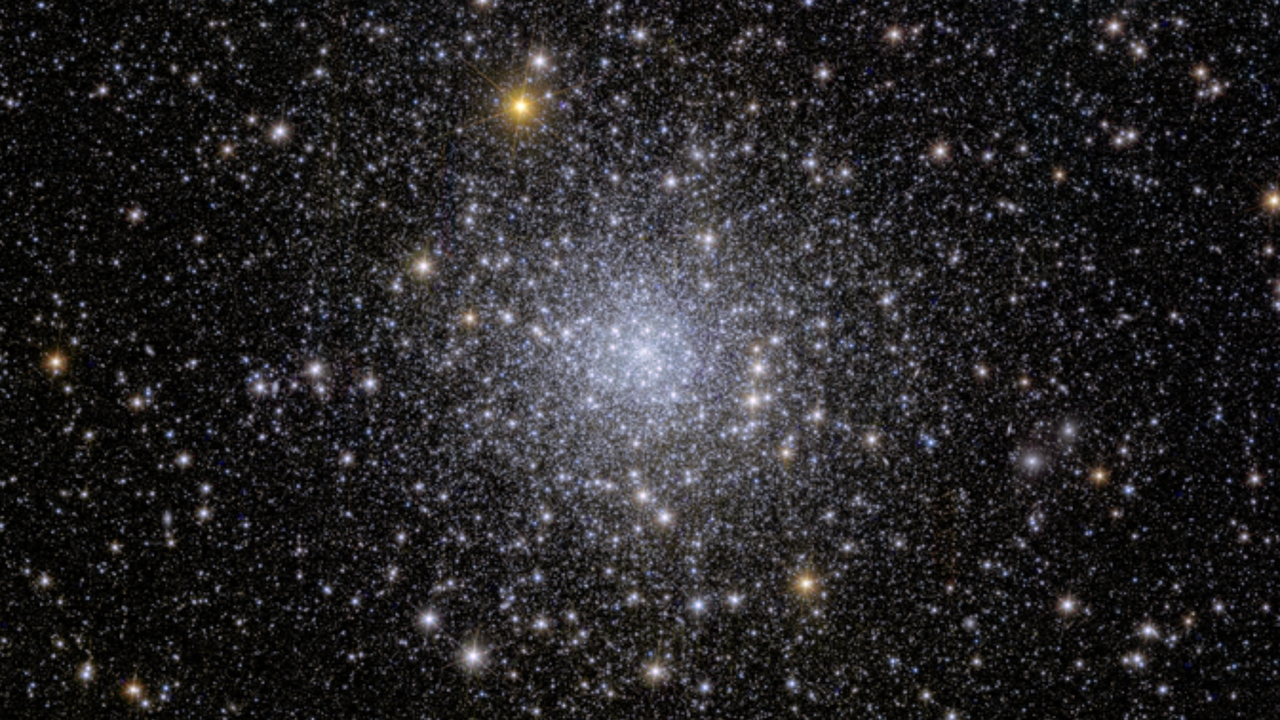
The Euclid space telescope has detected an unexpected gap in the stellar distribution of the ancient globular cluster NGC 6397, located roughly 7,600 light-years from Earth. The discovery emerged from observations of red dwarf stars within the cluster, where astronomers noticed a subtle but definite absence of stars in a particular region of the brightness distribution.
This gap represents a genuine void in the population of faint, low-mass stars that should occupy that brightness range. Researchers did not set out hunting for this feature. Instead, it surfaced during routine analysis of Euclid's high-resolution imaging data, which captured the cluster's stellar population with unprecedented precision.
NGC 6397 ranks among the nearest globular clusters visible from Earth, making it an ideal laboratory for studying stellar dynamics and evolution. Globular clusters contain hundreds of thousands to millions of stars bound together by gravity, and their structure records billions of years of stellar history. The presence of such a gap carries implications for understanding how stars in these dense environments interact and evolve.
The missing patch likely reflects a combination of physical processes. Dynamical interactions between stars, mass segregation where heavier objects sink toward the cluster's core, and stellar evolution timescales all play roles in shaping stellar populations. The gap may indicate a generation of stars that either evolved away from that brightness range or was depleted by gravitational encounters.
Euclid, a joint mission of the European Space Agency and NASA launched in 2023, operates with instrumentation sensitive enough to resolve individual stars even in crowded stellar fields. Its primary mission targets dark matter and dark energy across the universe, but its observational power yields discoveries across multiple astronomical domains.
This serendipitous finding underscores how modern space telescopes reveal details invisible to previous generations of instruments. The gap in NGC 6397 presents a puzzle that will require additional observation and modeling