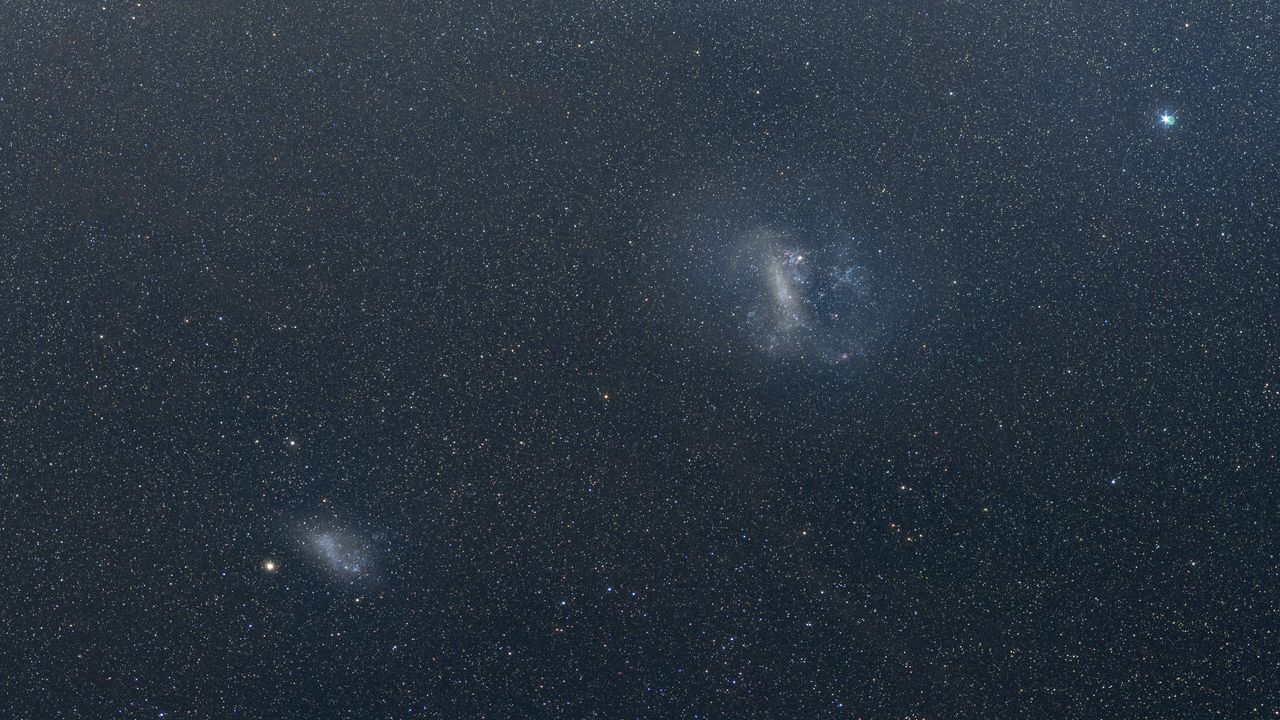
The Large Magellanic Cloud (LMC) is actively tearing apart the Small Magellanic Cloud (SMC), two dwarf galaxies locked in a gravitational dance that spans billions of years. Both galaxies orbit the Milky Way, likely on their first passage through our galactic neighborhood, and their interaction offers astronomers a rare window into how gravity reshapes stellar systems over cosmic timescales.
The LMC, the more massive of the pair, exerts tremendous gravitational pull on its smaller companion. This tidal force stretches and distorts the SMC's structure, pulling stars and gas streams away from its core. Observations from space telescopes reveal streams of material extending across tens of thousands of light-years, evidence of the relentless gravitational disruption occurring in real time.
What makes this interaction scientifically valuable extends beyond the drama of galactic destruction. The Magellanic Clouds serve as laboratories for understanding stellar populations, star formation rates, and the dynamics of dwarf galaxies themselves. Astronomers study how gravitational interactions trigger or suppress new star birth, how they redistribute gas and dark matter, and what mechanisms govern the survival or dissolution of smaller galaxies near massive ones like the Milky Way.
The fact that these dwarf galaxies appear to be making their first approach to the Milky Way makes their study particularly relevant. Many models of galactic evolution assume repeated passages and extended orbital histories. The LMC and SMC represent a cleaner case study, with interactions driven primarily by the forces between them and the Milky Way's gravity field, less complicated by prior encounters.
Current data suggests the SMC will eventually be completely consumed by the LMC within the next few billion years, a merger that will fundamentally alter both systems. Meanwhile, the LMC itself will eventually fall into the Milky Way, a collision predicted to