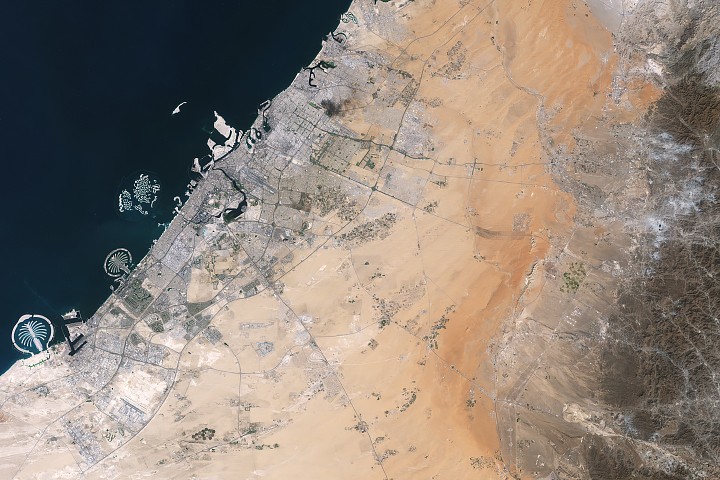
Archaeologists working at Jabal al Fāyah in the United Arab Emirates have uncovered evidence of human occupation dating back 127,000 years, making it one of the oldest known sites of early human presence outside Africa. The rocky outcrop, now surrounded by desert, once lay beneath a shallow sea during periods when global sea levels rose and fell with ice age cycles.
The site reveals how early humans adapted to dramatic environmental shifts. Stone tools, animal remains, and other artifacts indicate that people occupied the location during multiple periods across tens of thousands of years. These inhabitants hunted large game and gathered plant resources in a landscape that transformed from coastal wetland to arid terrain as climate conditions changed.
Jabal al Fāyah's position along the Arabian Peninsula made it a crucial waypoint for human migration routes. The evidence suggests early humans successfully colonized diverse environments, from African savannas to Middle Eastern coastal regions, demonstrating remarkable behavioral flexibility and survival strategies. Stone tool technology recovered at the site shows continuity with African manufacturing traditions, supporting theories about human dispersal patterns from the continent.
The geological record at Jabal al Fāyah tells a story written in stone and sediment. Different layers preserve snapshots of ancient climates and human activity separated by thousands of years. During wetter periods, freshwater springs sustained both wildlife and human communities. As conditions dried, people either adapted to increasingly harsh terrain or migrated elsewhere.
This research challenges previous assumptions about the speed and extent of human expansion beyond Africa. Rather than rapid coastal migrations, the evidence points to gradual occupation of diverse habitats across many millennia. The site underscores how human survival hinged on understanding local resources and responding to environmental change, skills that proved essential as our species spread across the planet.