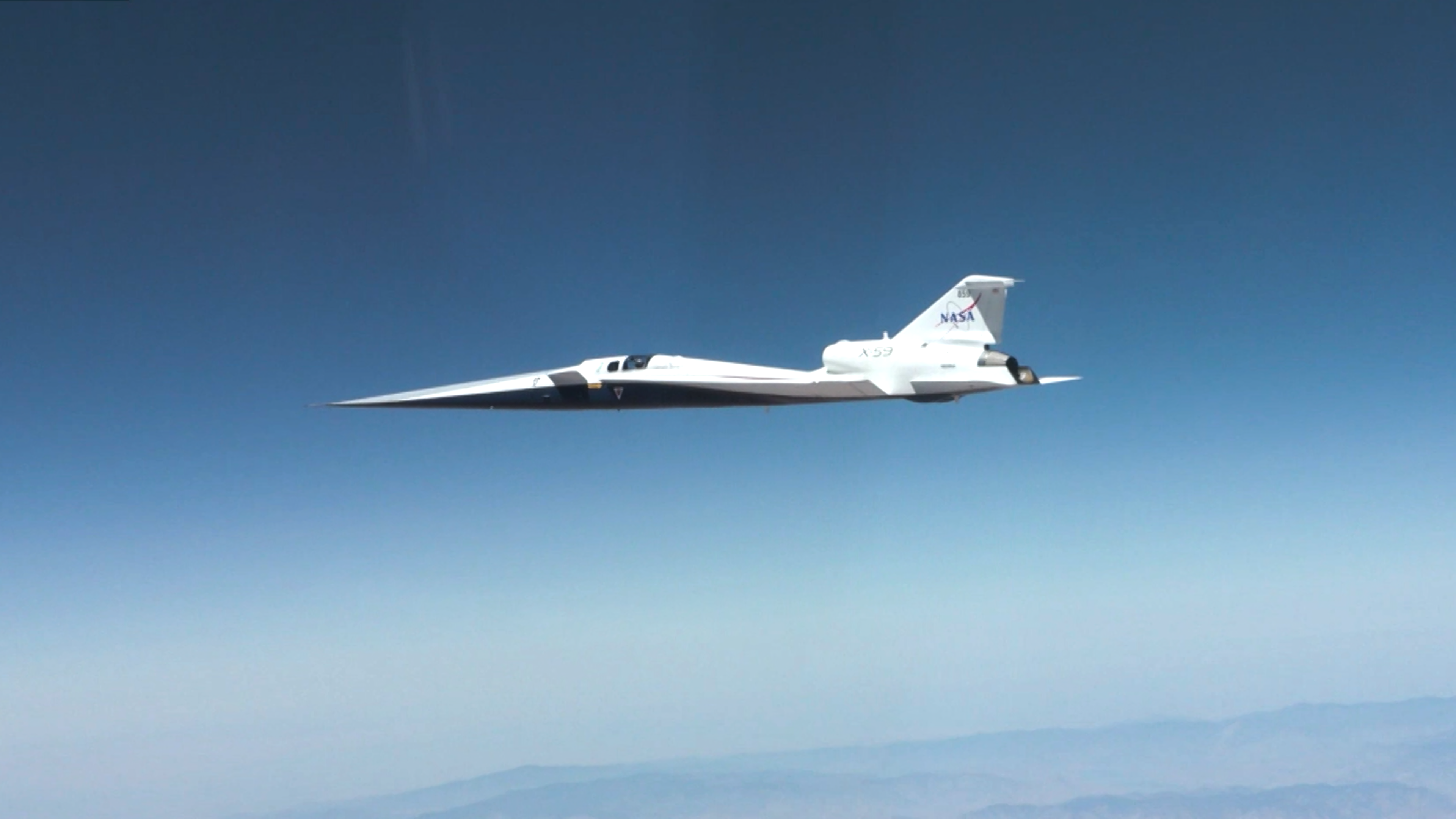
NASA's X-59 experimental aircraft achieved supersonic flight on June 5, 2026, with test pilot Jim "Clue" Less commanding the aircraft to Mach 1.1 (713 mph) during an 81-minute sortie from Edwards Air Force Base in California. This breakthrough marks a critical stepping stone toward demonstrating the aircraft's primary mission: proving that supersonic flight can be conducted with minimal sonic boom disturbance to communities below.
The X-59 represents a collaboration between NASA and Lockheed Martin's Skunk Works division, designed specifically to validate quiet supersonic technology. Unlike conventional supersonic aircraft that produce loud, jarring sonic booms, the X-59 employs specialized aerodynamic shaping to shape shock waves in ways that reduce noise signatures on the ground. Rather than a single sharp boom, the aircraft generates a sequence of quieter pressure waves.
The successful transonic and supersonic flight data collected during this mission provides engineers with real-world performance metrics on the aircraft's handling characteristics at these speeds. The team evaluated flying qualities across both subsonic and supersonic regimes, essential baseline information for the demonstrators planned later in 2026, when NASA will fly the X-59 over select U.S. communities to gather public response data on the quieter sonic signatures.
This work directly supports the Federal Aviation Administration's efforts to develop new rules permitting supersonic flight over land. Current regulations ban supersonic flight over populated areas due to noise concerns. If NASA successfully demonstrates that quiet supersonic flight is feasible, it could open pathways for future commercial supersonic aircraft to operate on transcontinental routes without regulatory prohibition, potentially reviving an era of faster-than-sound passenger travel that ended with Concorde's retirement in 2003.
The X-59 program validates decades of aeronautical research into shaped-sonic-boom diff