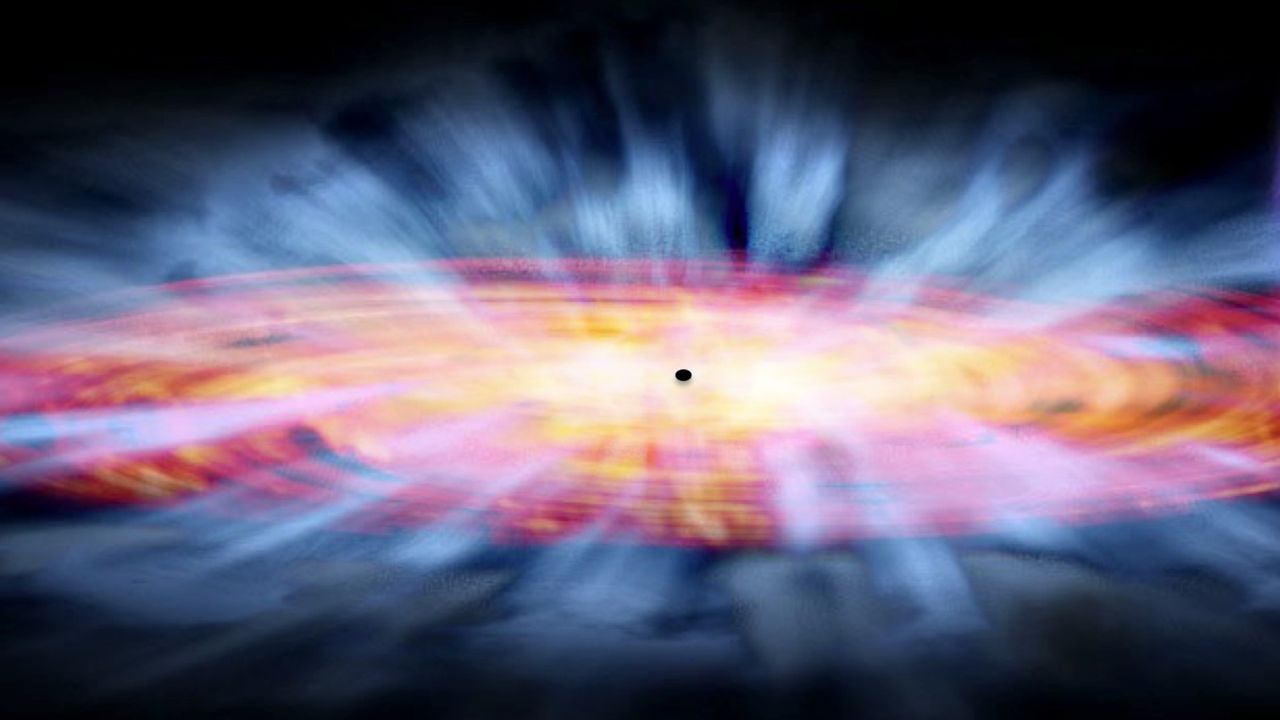
Astronomers have identified a quasar at the edge of the observable universe where a supermassive black hole generates winds traveling at 30 percent the speed of light. These outflows represent the fastest ultraviolet winds ever measured from an active galactic nucleus, according to observations combining data from multiple space telescopes.
The black hole accretes material at a tremendous rate, superheating gas and ejecting it at relativistic speeds. These winds carry enough kinetic energy to reshape entire galaxies, stripping away gas needed for star formation and regulating how galaxies grow over cosmic time. If such a wind existed on Earth, it would constitute a Category 79 hurricane, a comparison that underscores the raw power involved, though Earth's atmosphere would evaporate long before such velocities manifested.
The discovery emerges from detailed spectroscopic analysis using ultraviolet observations. Previous measurements of black hole winds focused on X-ray wavelengths, which typically reveal slower outflows. This ultraviolet detection extends our understanding of the multi-wavelength nature of these phenomena and demonstrates that black hole feedback operates across the electromagnetic spectrum.
The quasar's tremendous energetic output stems from the supermassive black hole consuming infalling material at maximum rates. As mass spirals inward, friction and magnetic fields accelerate particles to extreme velocities before ejection along the black hole's rotational axis and at wider angles. These winds escape the black hole's immediate vicinity and propagate outward, eventually depositing energy into the surrounding intergalactic medium.
Understanding these high-speed outflows refines models of galaxy formation and evolution. Supermassive black holes fundamentally shape their host galaxies through such feedback mechanisms, limiting the size galaxies can achieve and determining when star formation halts. This discovery, likely identified through facilities like the Hubble Space Telescope, Chandra X-