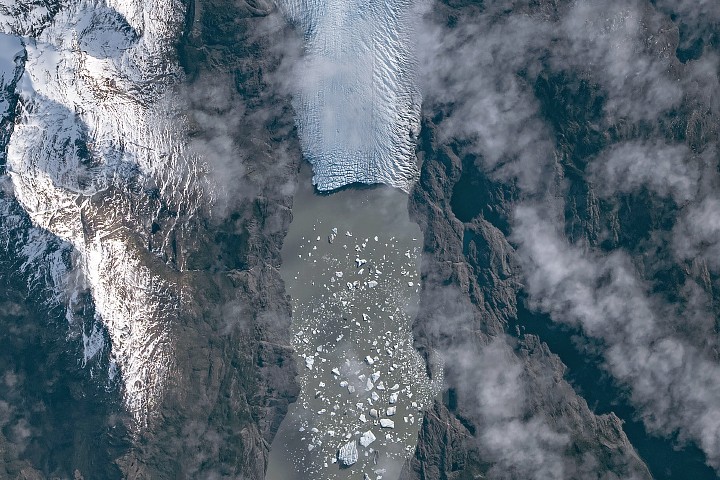
NASA satellite imagery captures the calving process at Tyndall Glacier in southern Patagonia, where massive chunks of ice break away and drift across an expanding proglacial lake. The photographs document ongoing glacier retreat, a direct response to warming temperatures in the region.
Tyndall Glacier, part of the Southern Patagonia Icefield, has experienced dramatic mass loss over recent decades. The formation of the glacial lake itself represents a visible marker of ice loss. As the glacier retreats, meltwater fills the depression left behind, creating a lake that grows larger each season. Icebergs calve from the glacier's terminus and float in these waters, eventually melting.
NASA's Earth observation satellites provide continuous monitoring of glacial systems worldwide. This data reveals patterns of change impossible to track from ground level alone. The agency documents ice sheet dynamics, seasonal variations, and long-term trends that inform climate science and glacier modeling.
Patagonian glaciers rank among Earth's most sensitive indicators of climate change. The region experiences rapid warming, particularly at lower elevations where Tyndall sits. Annual ice loss in the Southern Patagonia Icefield exceeds one billion tons. Scientists use satellite records spanning decades to measure recession rates and project future changes.
Tyndall Glacier's retreat directly impacts downstream water resources and ecosystems. The freshwater discharge from melting ice affects fjord chemistry and marine habitats. Indigenous communities and local populations depend on glacial systems for water supplies. Understanding these changes becomes essential for adaptation planning.
NASA's monitoring networks include the Landsat program and newer instruments aboard current satellites. These tools track visible changes like calving events, surface melt patterns, and glacier boundaries with unprecedented precision. The data enters climate models that predict how ice systems will respond to future warming scenarios.
Glacial lakes now dot Patagonia where solid ice existed