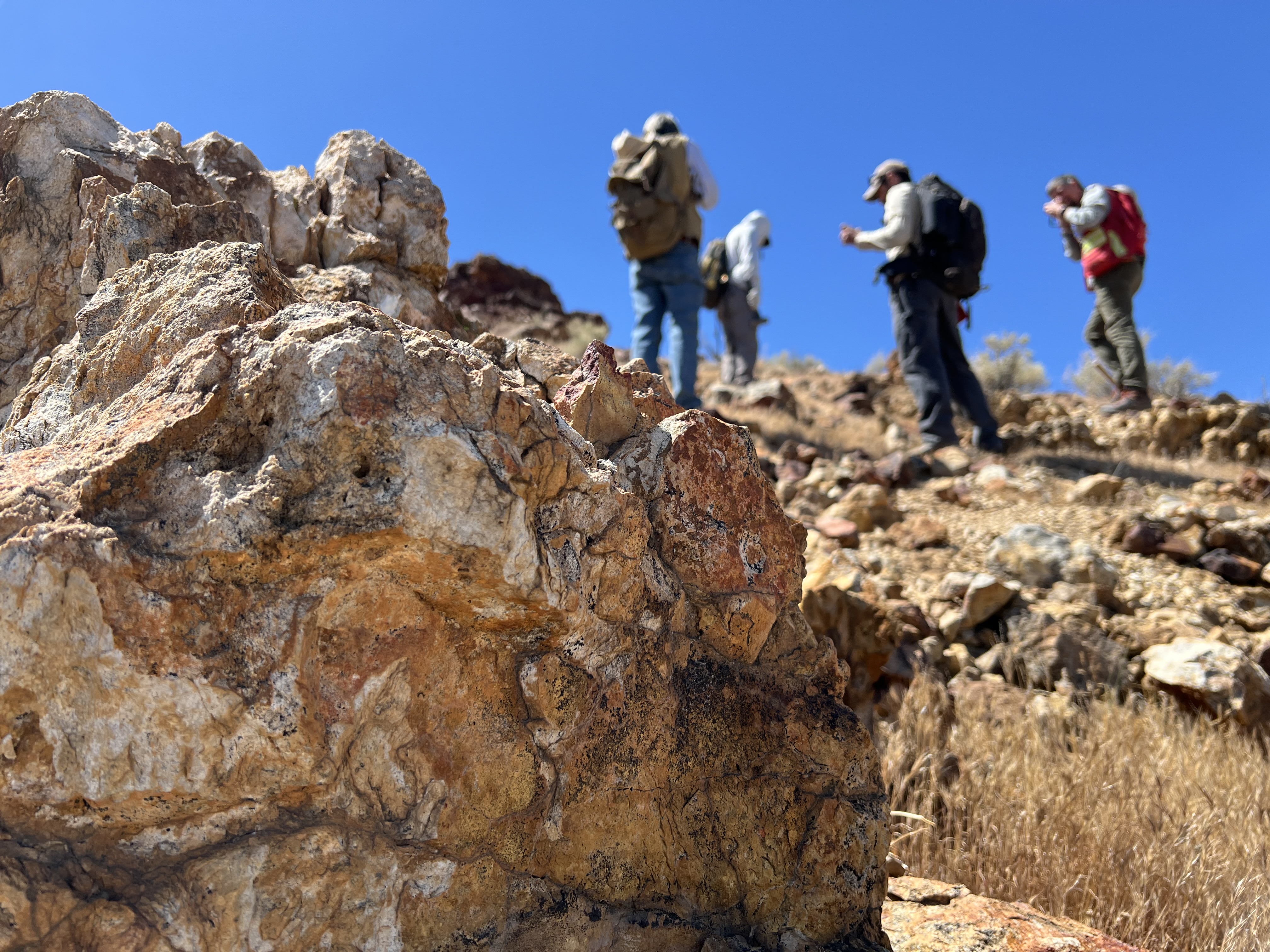
NASA and U.S. Geological Survey scientists deployed to California's Mojave Desert to investigate mineralogical signatures detected by orbital sensors, targeting deposits of topaz that may reveal clues about subsurface hydrothermal processes. The research team used traditional field geology techniques—rock picks and hand lenses—to ground-truth spectroscopic data collected from space.
Topaz formation requires specific thermal and chemical conditions. Its presence in surface outcrops indicates past fluid circulation through rock systems, a process that concentrates valuable elements and creates ore deposits. By correlating spectroscopic "fingerprints" detected by NASA sensors with physical samples, geoscientists refine their ability to identify mineral assemblages remotely.
This work advances planetary exploration methodology. NASA instruments that detect mineral compositions in the Mojave Desert operate with the same physics underlying Mars and lunar reconnaissance. The Thermal Emission Spectrometer and similar instruments aboard orbiters map mineralogy by reading how rocks absorb and emit infrared radiation at specific wavelengths. Validating these remote observations against ground truth strengthens interpretations of extraterrestrial geology.
The Mojave field campaign bridges laboratory spectroscopy and real-world complexity. Rocks weather. Dust obscures surfaces. Mineral mixtures blur spectral signatures. By documenting how sensors perform across varied terrain and conditions, researchers build confidence in assessments of Mars rover targets or lunar landing site geology. They also improve protocols for future human missions requiring rapid geological assessment.
The collaboration between NASA and USGS reflects the agency's commitment to understanding Earth as an analog for planetary science. Techniques perfected in accessible deserts transfer directly to robotic missions on Mars and Moon operations. The topaz investigation demonstrates that fundamental Earth geology remains integral to space exploration, not as metaphor but as direct methodology transfer.