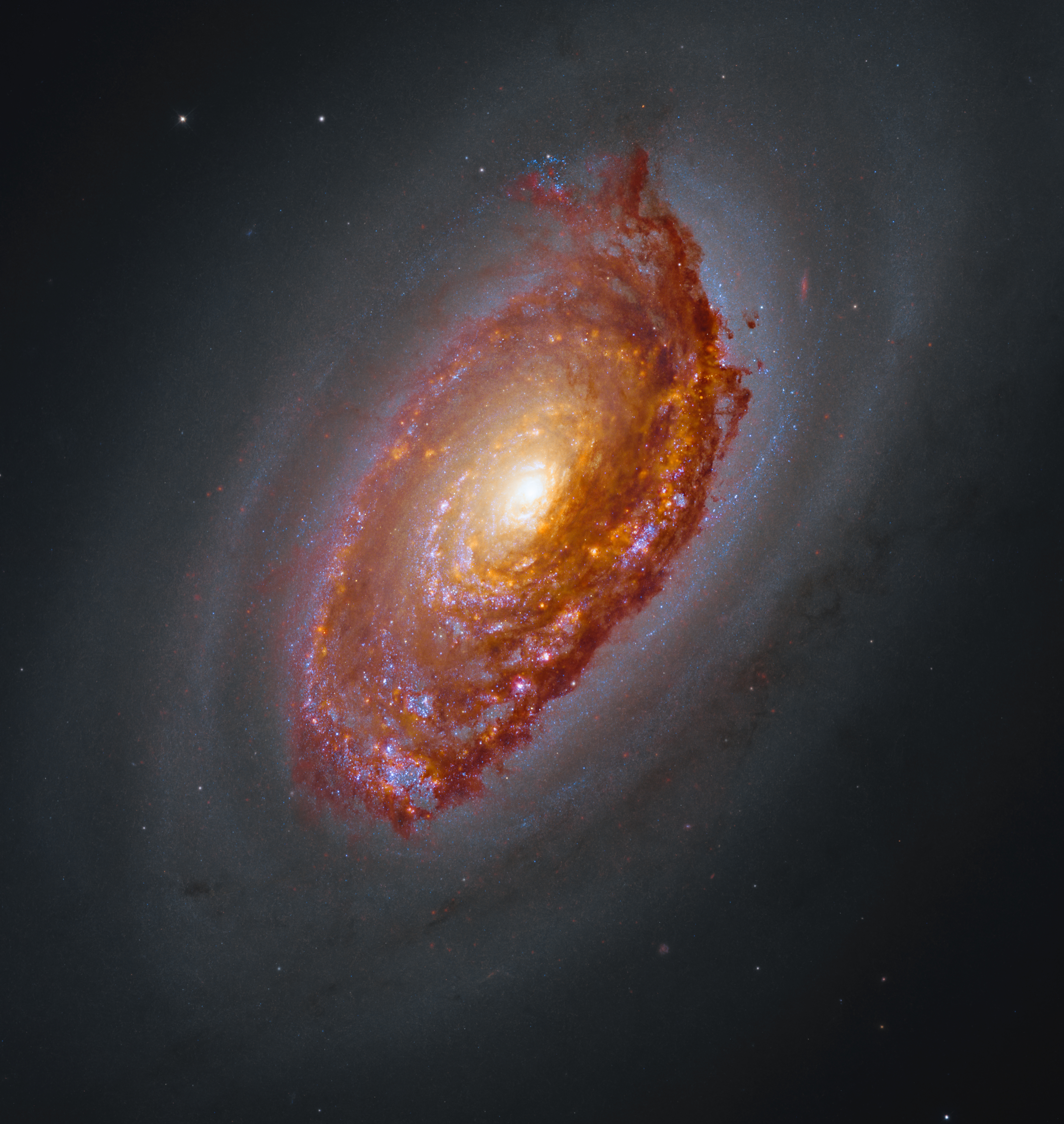
NASA's Hubble Space Telescope and James Webb Space Telescope have jointly captured Messier 64, the Black Eye Galaxy, revealing the structure of this peculiar spiral galaxy in unprecedented detail. The composite image released March 20, 2026, combines Hubble's ultraviolet, visible, and near-infrared observations with Webb's mid-infrared data to create a comprehensive view across the electromagnetic spectrum.
Messier 64 earned its nickname from the dark dust lane that crosses its face, creating the appearance of a closed eye when viewed through ground-based telescopes. Located approximately 17 million light-years away in the constellation Coma Berenices, this galaxy represents a merger in progress. Its counter-rotating disks indicate that Messier 64 collided with another galaxy in the past, a cosmic collision that continues to reshape its structure today.
The infrared perspective from Webb penetrates the galaxy's dust clouds, revealing star formation regions hidden from visible-light observation. Hubble's ultraviolet and visible data traces the locations of young, hot stars scattered throughout the galaxy's spiral arms. Combined, these wavelengths expose the full complexity of galactic evolution and the ongoing stellar birth occurring within Messier 64's disrupted disk.
This multi-wavelength approach demonstrates how modern space telescopes collaborate to answer fundamental questions about galaxy dynamics. The complementary capabilities of Hubble and Webb allow astronomers to track both the ancient stellar populations and the active star formation simultaneously. Such observations refine our understanding of how galaxies merge, how collisions affect star birth rates, and how spiral structure persists through gravitational upheaval.
The Black Eye Galaxy serves as a nearby laboratory for studying galactic interactions, processes that dominated the early universe when collisions between galaxies were far more frequent. By examining Messier 64's peculiar structure in detail, astronom