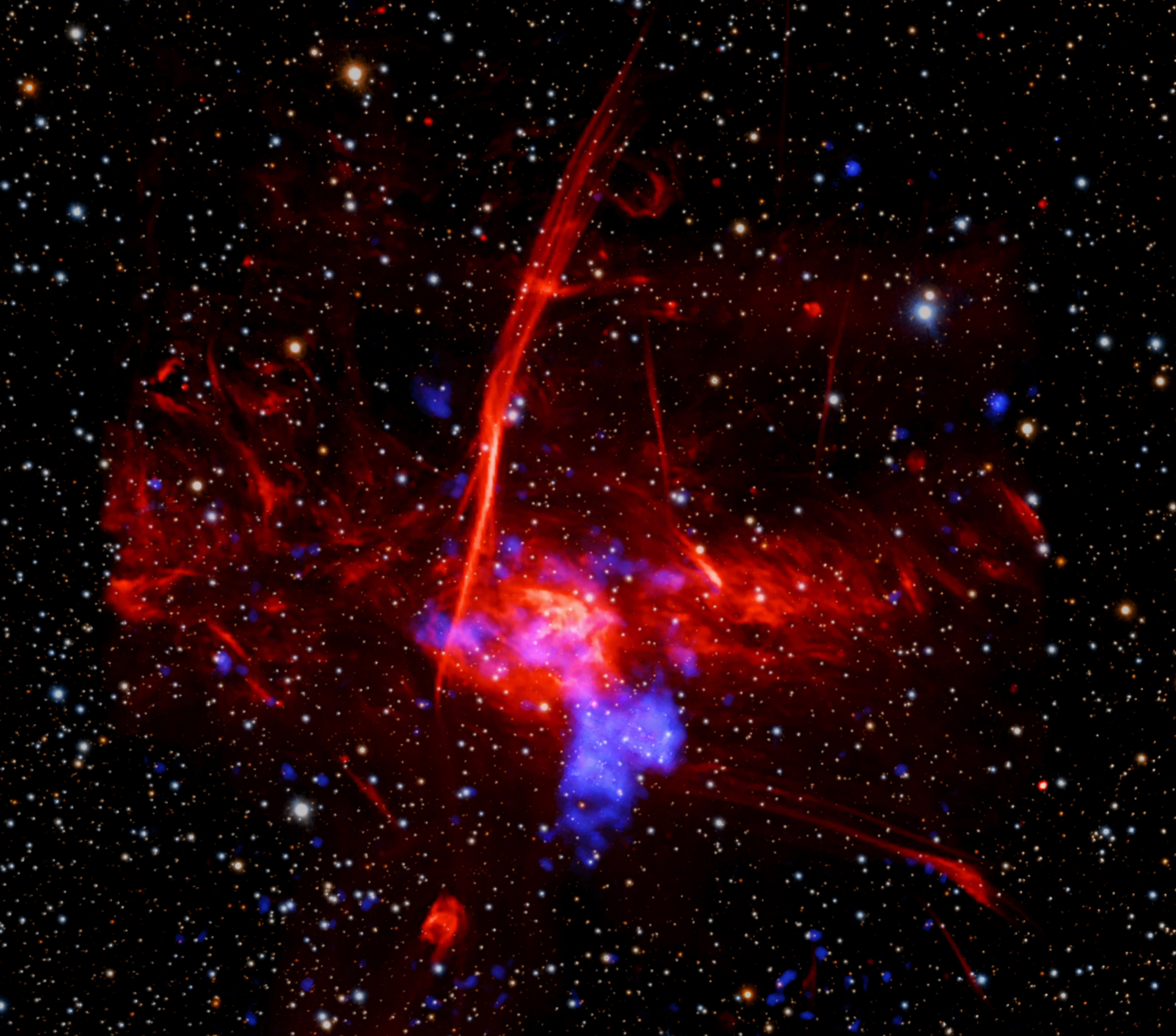
NASA's Chandra X-ray Observatory has detected what appears to be a supernova remnant lurking within the crowded environment of the galactic center. The discovery, published in The Astrophysical Journal, reveals an expanding shell of stellar debris in one of the most extreme regions of the Milky Way.
Supernova remnants represent the violent aftermath of stellar explosions. These expanding clouds contain heavy elements forged in the dying star's core, including iron, oxygen, and silicon. Finding such a remnant in the galactic center presents a research puzzle. The region teems with intense radiation, powerful magnetic fields, and dense stellar populations that typically obscure X-ray signals from fainter sources.
Chandra's X-ray sensitivity proved essential for this detection. The observatory operates at wavelengths invisible to human eyes, penetrating dust that blocks visible light and revealing hot gas structures that ground-based telescopes cannot see. X-rays emit from supernova remnants as shock waves heat surrounding gas to millions of degrees.
The galactic center harbors Sagittarius A*, a supermassive black hole four million times the Sun's mass, along with dense star clusters and complex magnetic structures. Identifying individual objects within this chaos demands precision instruments. Chandra's resolution allows astronomers to distinguish point sources and extended structures within crowded fields.
This discovery contributes to understanding stellar death across the galaxy. Supernova remnants seed interstellar space with enriched material, fueling the formation of new stars and planets. Tracking remnants in diverse galactic environments reveals how supernovae distribute elements throughout the Milky Way.
The research also demonstrates how space-based X-ray observatories remain indispensable for galactic archaeology. Chandra, launched in 1999, continues producing discoveries that ground-based instruments cannot achieve. This detection adds