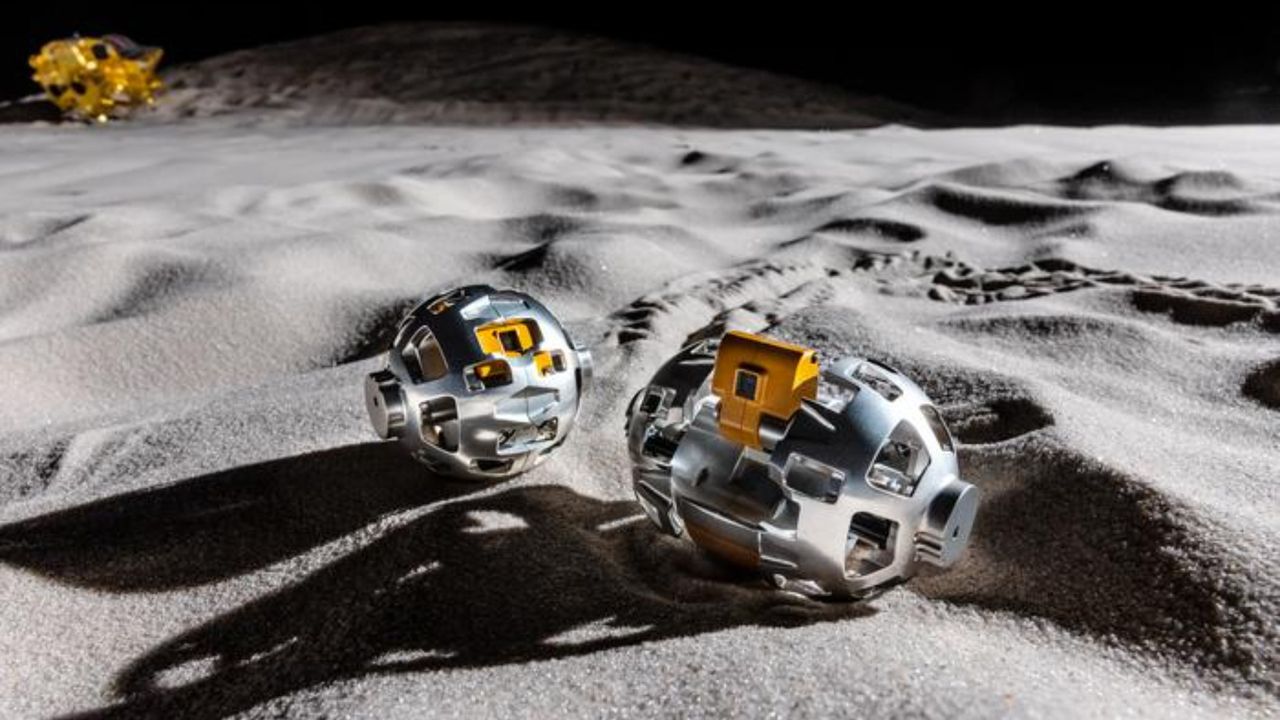
Japan's space agency achieved a remarkable feat by deploying an autonomous rolling rover to the lunar surface that literally transforms from a sphere into a bipedal robot. The JAXA mission successfully operated this shapeshifting explorer during 2024 lunar operations.
The rover, developed through collaboration between JAXA and roboticists, represents a breakthrough in lunar mobility design. Rather than relying on wheels or tracks like traditional rovers, this robot exploits its transformable geometry to navigate the moon's harsh terrain. The spherical configuration allows it to roll efficiently across relatively smooth surfaces, while the bipedal stance provides stability and maneuverability over rocky, uneven ground that would challenge conventional wheeled designs.
The mission deployed the rover to explore specific regions on the lunar surface, gathering data on soil composition, radiation exposure, and surface conditions. Its dual-mode locomotion system proved adaptable to obstacles and variations in terrain that a single-mode rover would struggle with. This flexibility directly addresses one of lunar exploration's persistent challenges: designing vehicles that handle the moon's diverse surface features without sacrificing mobility or science capability.
JAXA's achievement opens new pathways for future lunar exploration missions. The transforming robot concept could enhance how space agencies approach rover design for forthcoming crewed and uncrewed missions to the moon and beyond. The technology demonstration validates principles that could extend to Mars rovers and other planetary exploration platforms, where terrain diversity demands adaptive systems.
The successful 2024 operation marks a transition from theoretical robotics concepts to proven hardware performing real science on an extraterrestrial world. Japan joins NASA, China, and other spacefaring nations in advancing lunar mobility technology, though its approach through transforming design represents a distinctly innovative contribution to the field. The rover's performance data will inform next-generation explorer designs as humanity builds the infrastructure for sustained lunar presence.