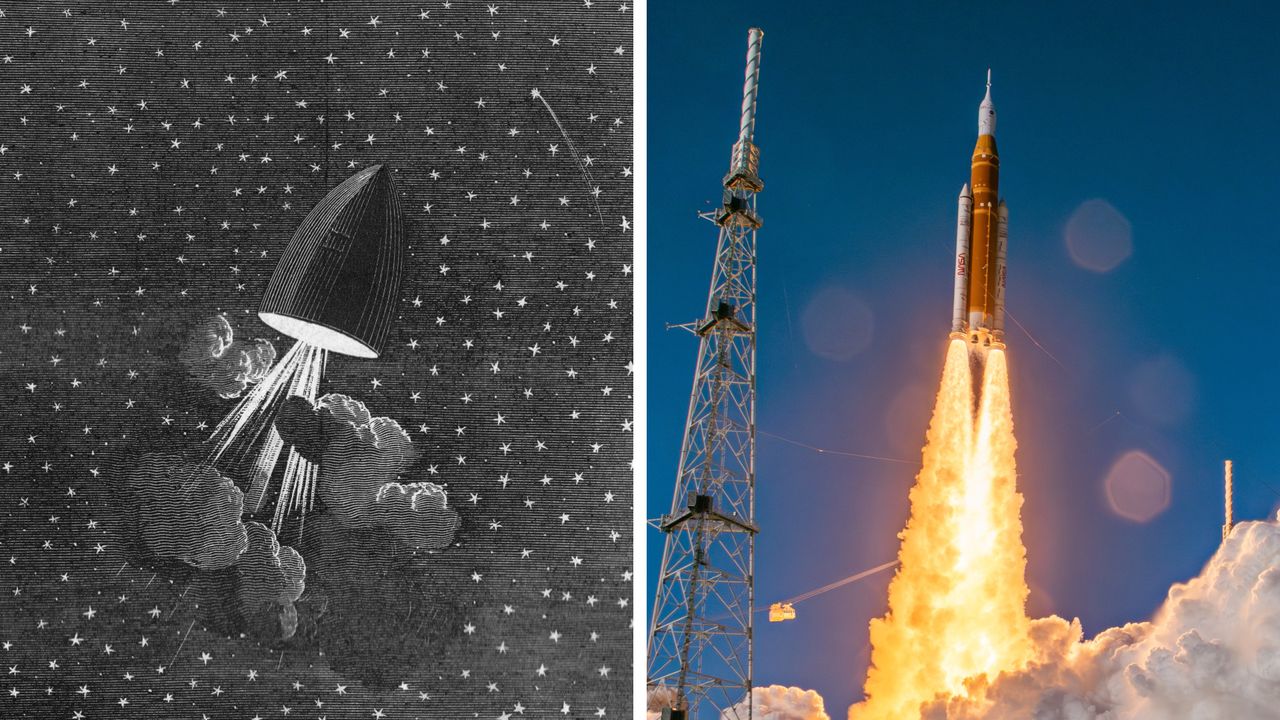
Jules Verne's 1860s science fiction novels predicted the fundamental architecture of NASA's Artemis 2 mission with startling accuracy. The French author's "From the Earth to the Moon" and "All Around the Moon" described a three-person crew traveling in a conical capsule on a free-return trajectory around the moon, a concept that NASA will execute in 2025.
Artemis 2 will carry three astronauts aboard the Orion spacecraft, a capsule shaped precisely as Verne imagined. The mission follows a free-return trajectory, meaning the spacecraft uses the moon's gravity to redirect its path back to Earth without requiring mid-course corrections. This approach minimizes fuel consumption and maximizes safety, a principle NASA selected for its lunar architecture more than a century after Verne conceived it.
The parallels extend beyond mere coincidence. Verne grounded his fiction in the physics available to him, calculating trajectories and escape velocities with reasonable accuracy for the era. He understood that lunar missions required ballistic precision and understood the mathematics of orbital mechanics in ways most of his contemporaries did not. His novels synthesized existing scientific knowledge into plausible spacecraft designs, demonstrating how informed speculation bridges imagination and engineering.
Artemis 2 represents the practical realization of Verne's vision. Crewed by Commander Reid Wiseman, Pilot Victor Glover, and Mission Specialist Christina Koch, the mission will execute a ten-day lunar flyby without landing, testing life support systems and crew procedures before Artemis 3 attempts a surface touchdown. The Orion capsule's conical shape manages heat loads during reentry while providing structural efficiency, precisely the engineering priorities Verne had identified.
This convergence reveals something fundamental about space exploration. The constraints of physics remain constant. A three-person crew balances redundancy with