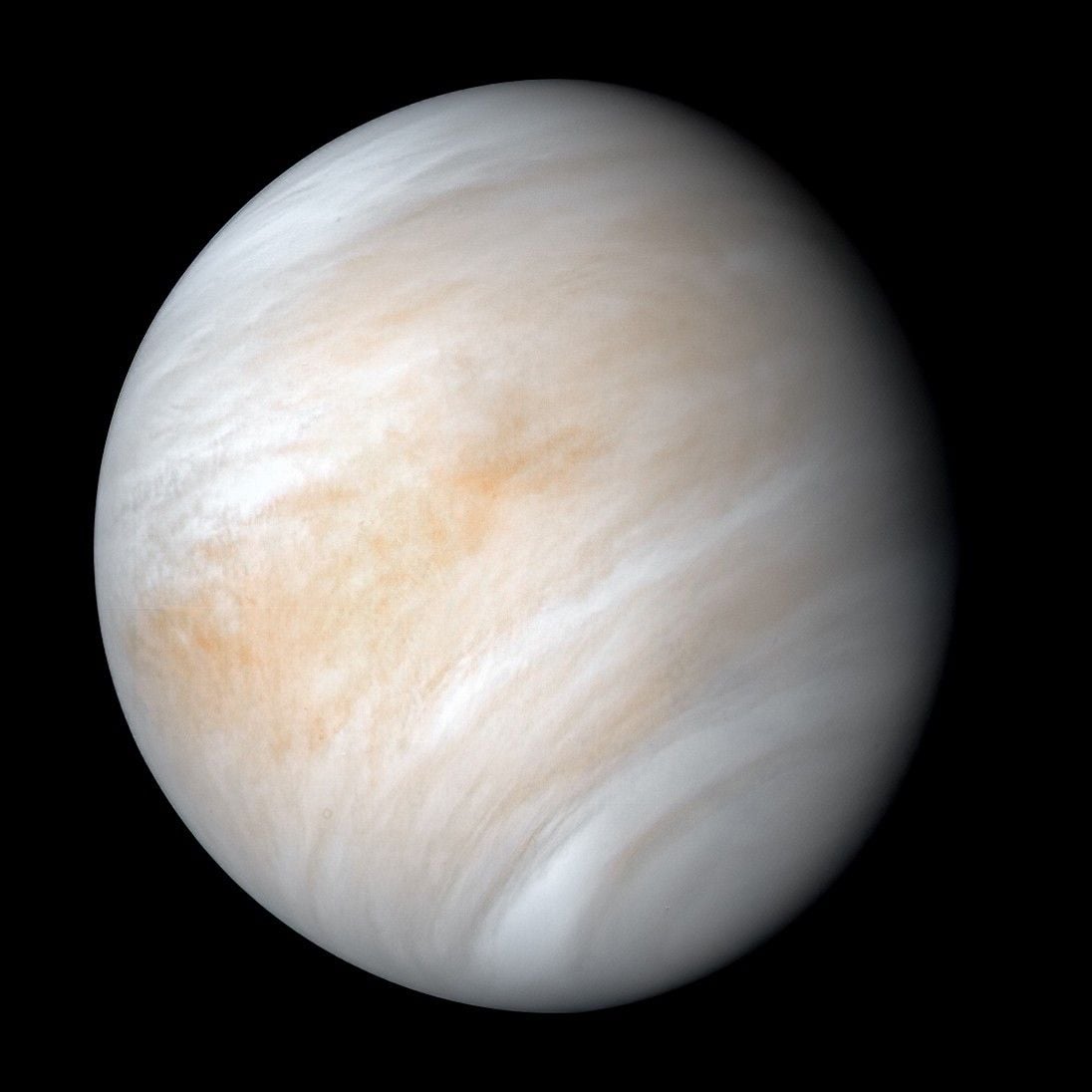
Venus rotates backwards and at an agonizingly slow pace. A massive collision early in the solar system's history likely explains both oddities.
New research proposes that a moon-sized impactor struck Venus approximately 4.5 billion years ago at a steep angle and extreme velocity. The impact's geometry and force altered the planet's rotation fundamentally, flipping its direction retrograde relative to most other planets and slowing it to a crawl. Venus now completes one rotation every 243 Earth days, making it slower than Mercury despite orbiting closer to the Sun.
This scenario solves a persistent puzzle in planetary science. Venus's retrograde rotation defies the standard solar system formation model, where planets accumulate angular momentum from their accretion disk in the same direction. The slow rotation also creates Venus's bizarre day-night cycle. A Venusian day lasts longer than a Venusian year, producing an exotic temporal environment.
The impact hypothesis explains both anomalies simultaneously. A glancing collision with sufficient energy could impart angular momentum in reverse while bleeding away rotational speed. The specific geometry matters. A direct head-on strike produces different results than the high-angle, high-velocity encounter the research describes.
Venus's retrograde rotation occurs in only two cases in our solar system. Venus exhibits it, and so does Uranus, which scientists attribute to a catastrophic collision during planet formation. The mechanism explains how giant impacts reshape planetary properties fundamentally.
Understanding Venus's rotation history carries implications beyond pure planetary science. It reveals how violent collisions shaped the early solar system and influenced habitability. Earth itself experienced the Moon-forming giant impact around 4.5 billion years ago, an event that established our planet's 24-hour day. Venus's collision occurred around the same epoch, suggesting a period of intense bombardment sculpted the inner solar system's fundamental characteristics.