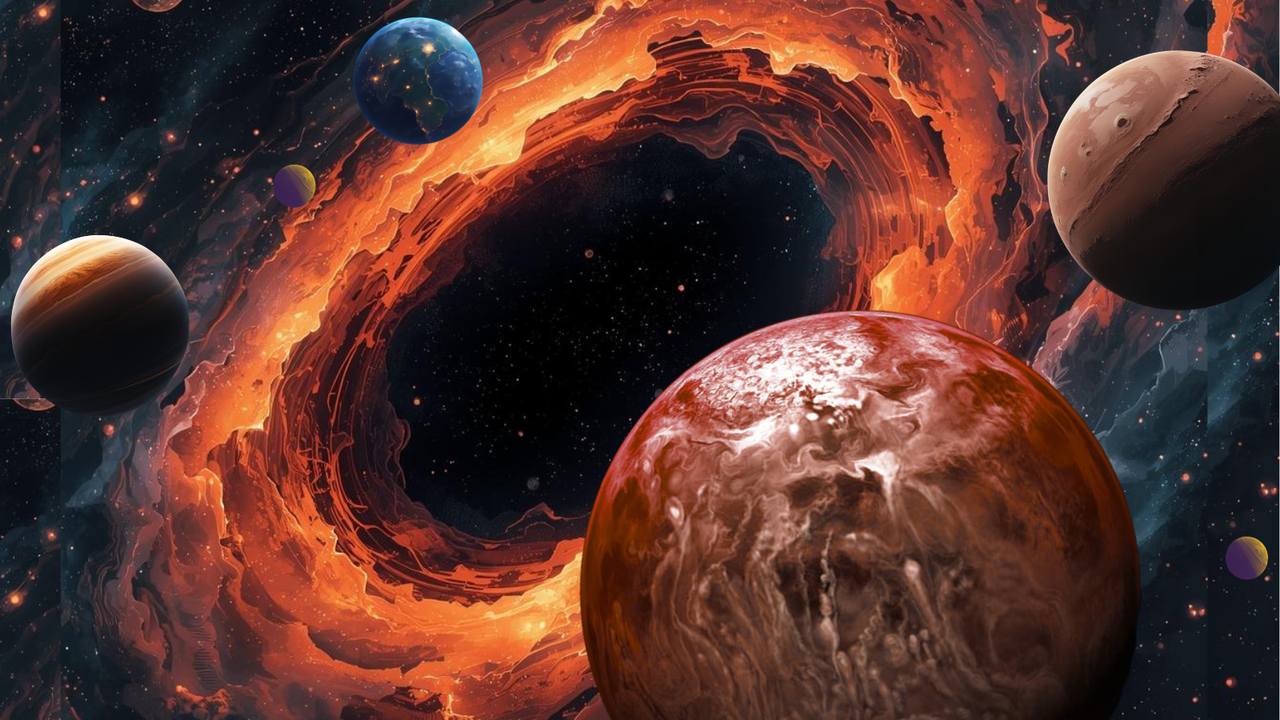
Astronomers have discovered that planetary formation occurs readily in the turbulent regions surrounding active supermassive black holes, a finding that upends conventional assumptions about where worlds can emerge.
The research reveals that planets form in the inner accretion disks of active galactic nuclei, where gravitational forces and radiation from feeding black holes create conditions researchers previously considered hostile to planet birth. The team detected evidence of planets across a broad mass and size range in these extreme environments, suggesting that millions of planets populate the regions nearest to black holes across the observable universe.
"We were totally amazed when we noticed this mass and size range of planet formation," the researchers stated, reflecting the surprise of discovering such prolific planetary genesis in regions thought inhospitable to world formation.
The mechanism involves dust and gas in the accretion disk coalescing into planetary embryos faster than the black hole can consume the material. The intense radiation and chaotic dynamics near these supermassive monsters accelerate the dust aggregation process, allowing planets to grow from microscopic grains to full-sized worlds before orbital decay carries them into the black hole itself. Some planets survive by migrating outward to more stable orbits.
This discovery expands the cosmic real estate available for planets substantially. Galactic nuclei host some of the densest concentrations of matter in the universe, and if planet formation thrives there routinely, the total population of exoplanets could exceed prior estimates by orders of magnitude.
The findings carry implications for astrobiology as well. Planets forming near active black holes experience extreme radiation exposure, making them inhospitable to life as understood on Earth. However, their prevalence reshapes discussions about planetary demographics across the universe and the diversity of formation environments that produce worlds.
Understanding planetary genesis in these extreme settings tests theoretical models of accretion disk physics and challenges assumptions built into decades of planet formation research conducted around typical stars.