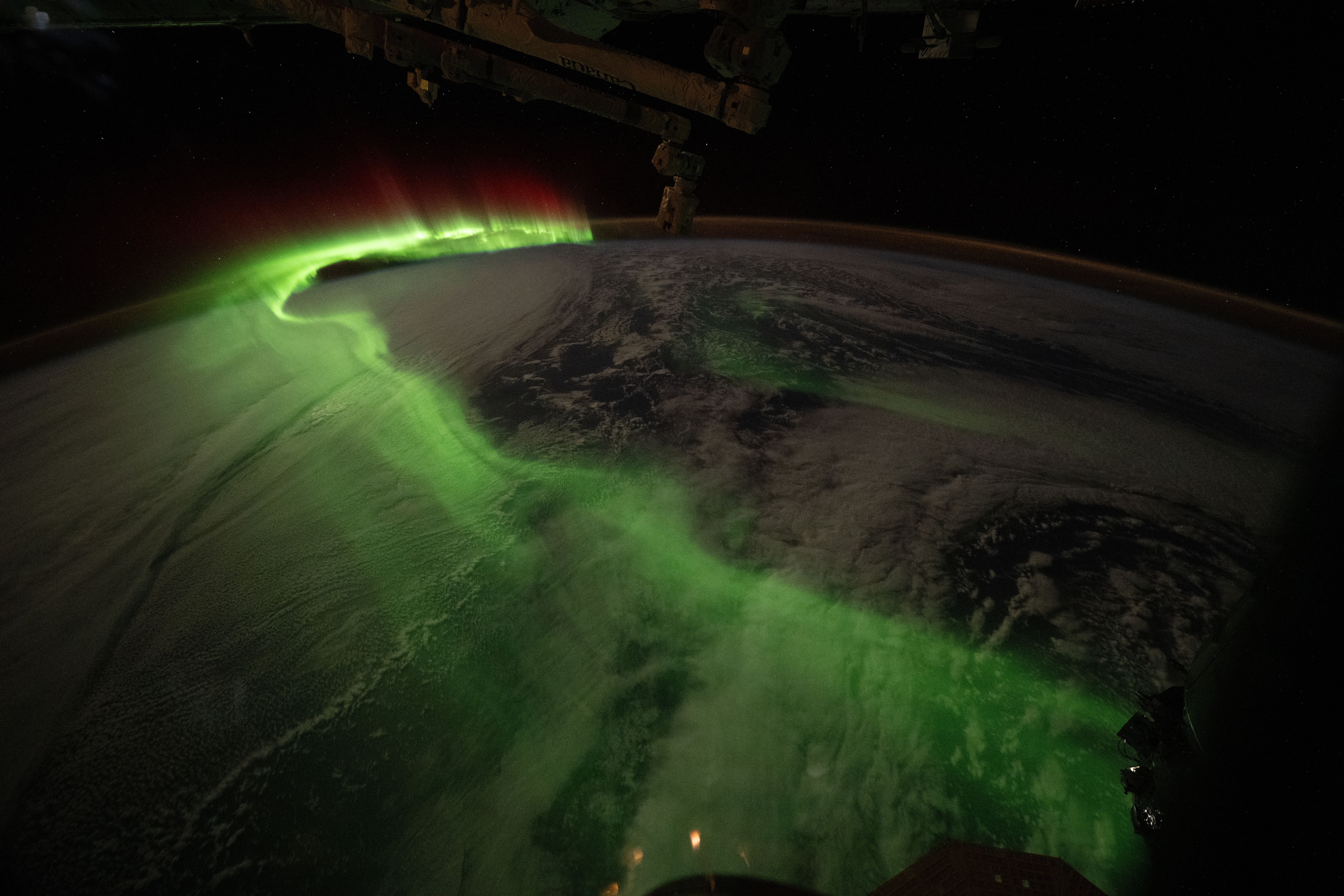
Astronauts aboard the International Space Station captured a striking photograph of the aurora australis on June 5, 2026, as the station orbited 271 miles above the Indian Ocean southwest of Perth, Australia. The image shows the southern lights arcing brilliantly during an active solar event, revealing the electromagnetic interaction between the sun's particles and Earth's magnetosphere.
Auroras form when charged particles from the solar wind collide with gases in Earth's upper atmosphere. During solar storms and coronal mass ejections, the sun ejects streams of energetic particles that reach Earth's magnetic field. These particles funnel toward the polar regions along magnetic field lines, where they excite oxygen and nitrogen molecules. Oxygen typically produces the characteristic green hues, while nitrogen can create red and blue coloration.
The ISS orbits at an altitude ideal for observing auroras from above. Astronauts can witness the full spatial extent of these phenomena across entire regions, providing perspectives impossible from ground-based observations. Each photograph documents the dynamic nature of Earth's magnetosphere during geomagnetic storms.
Solar activity follows an 11-year cycle, with the current solar maximum bringing increased aurora activity at both poles. This heightened period produces more frequent and extensive displays across higher latitudes. NASA and other space agencies track solar weather continuously using satellites like SOHO and DSCOVR to predict geomagnetic disturbances and issue alerts to power grids and communication networks.
Beyond their visual spectacle, auroras serve as natural laboratories for studying plasma physics and magnetospheric processes. Scientists use observations from space-based instruments and ground stations to understand how Earth's magnetic field responds to solar wind variations. The aurora australis captured from the ISS exemplifies how human spaceflight contributes to planetary science, offering vantage points that reveal the invisible forces protecting our atmosphere from the sun's relentless particle