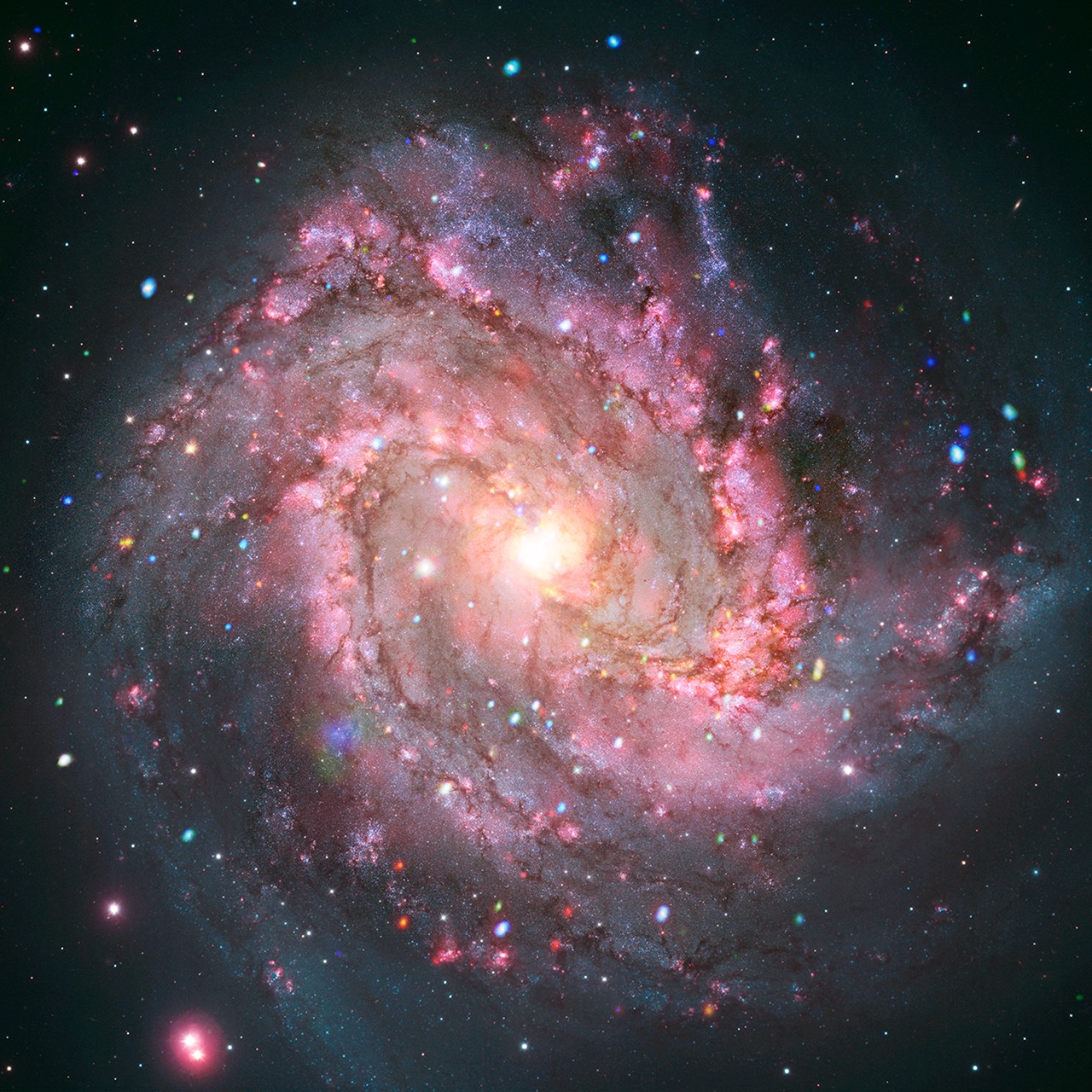
NASA's Chandra X-ray Observatory detected unexpected brightness variations in supernova remnants within the nearby galaxy Messier 83, challenging standard models of how stellar explosions fade over time.
Supernova remnants typically follow predictable cooling patterns as hot gas expands and dissipates after a star explodes. Instead, Chandra captured X-ray observations showing multiple remnants in M83 brightening and dimming dramatically across observation intervals. This behavior contradicts the assumed slow, monotonic decline astronomers expected from these debris clouds.
M83 sits approximately 15 million light-years away in the constellation Hydra, close enough for detailed study of its stellar violence. The galaxy hosts active star formation regions, generating frequent supernovae that leave observable remnants accessible to X-ray scrutiny. Chandra's sensitive instruments resolved individual remnants in ways optical telescopes cannot, revealing the high-energy processes governing their evolution.
The discovery forces reconsideration of supernova remnant physics. Several mechanisms could explain the observed flickering: density variations within the expanding gas shells, magnetic field interactions reshaping the plasma, or clumping of material that alternately heats and cools as it radiates energy. Each possibility carries implications for understanding shock dynamics, particle acceleration, and cosmic ray generation within these extreme environments.
Supernova remnants serve as laboratories for studying matter under conditions impossible to replicate on Earth. They accelerate particles to near light-speed, generate intense magnetic fields, and create the forge where elements heavier than iron form. Understanding their long-term brightness behavior refines models predicting how remnants evolve from violent explosions into diffuse gas that eventually merges with galactic material.
The Chandra findings underscore how X-ray astronomy continues revealing hidden physics in familiar cosmic phenomena. What appears settled through conventional understanding often yields surprises when examined with