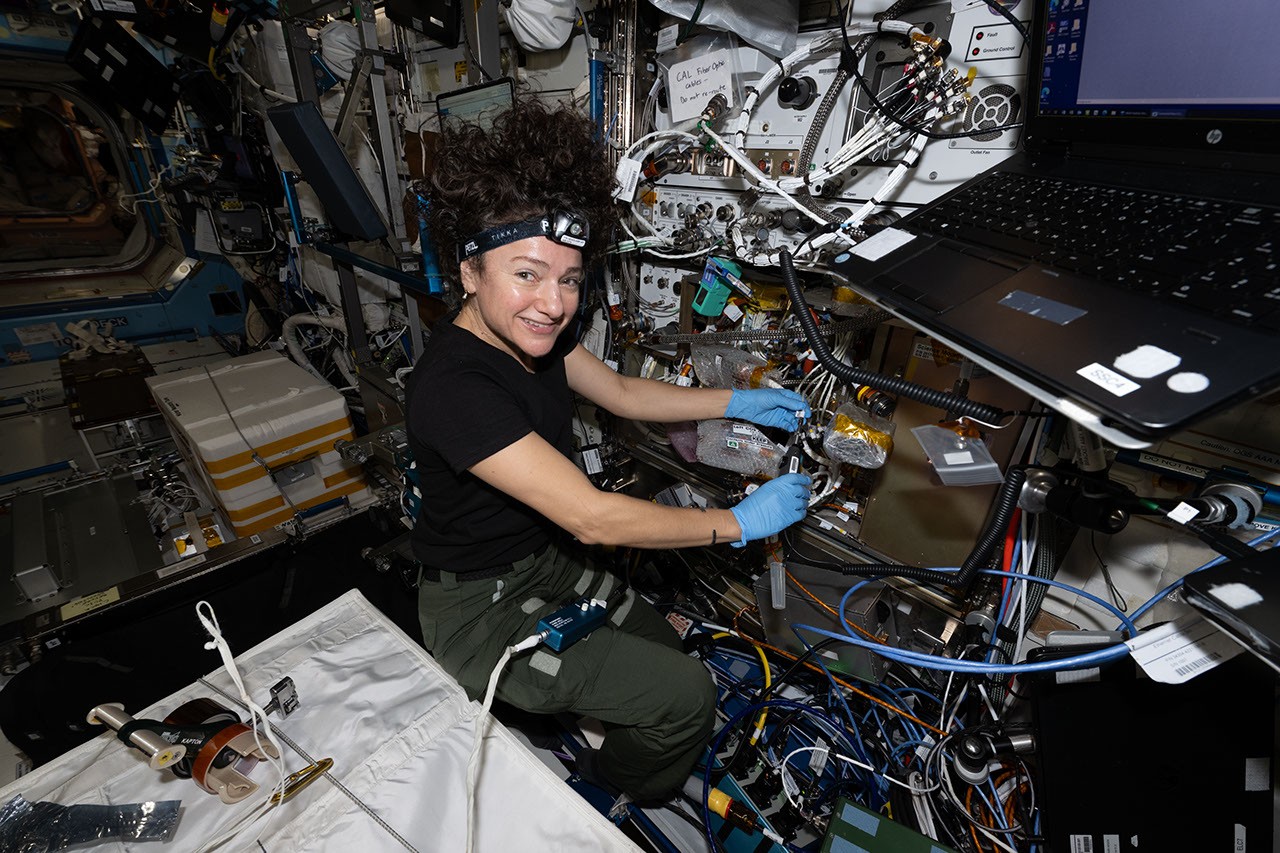
NASA astronaut Jessica Meir completed critical hardware upgrades to the Cold Atom Lab during a May 8, 2026 spacewalk aboard the International Space Station. Meir inspected optical fibers while installing the updates to this experimental instrument, which represents a frontier in quantum physics research conducted in microgravity.
The Cold Atom Lab, roughly the size of a minifridge, operates from Earth-based controls to cool atoms to temperatures near absolute zero, minus 459 degrees Fahrenheit (minus 273.15 Celsius). At these extreme temperatures, atoms enter a quantum state called a Bose-Einstein condensate, behaving as a single quantum entity rather than individual particles. This phenomenon remains impossible to study on Earth due to gravity's constant pull on matter.
The ISS provides the unique platform needed for this work. In microgravity, researchers can observe condensates for extended periods, revealing quantum behaviors that gravity masks planetside. The lab has already generated insights into quantum mechanics, relativity, and potential applications in precision measurement and navigation technologies.
Meir's hardware installation work ensures CAL continues generating scientific data that informs fundamental physics. The upgrades likely enhance the lab's observational capabilities or extend the duration of experiments possible in the orbiting laboratory. Such maintenance work exemplifies how the ISS functions as both a research destination and a testbed for increasingly sophisticated instruments.
The Cold Atom Lab represents a collaboration between NASA and multiple institutions pursuing basic science with practical implications. Quantum research conducted aboard the station advances technologies ranging from atomic clocks used in GPS systems to quantum computing. By maintaining and upgrading these instruments, Meir and her colleagues sustain the ISS's role as humanity's primary orbital laboratory for exploring the quantum realm beyond Earth's gravitational field.