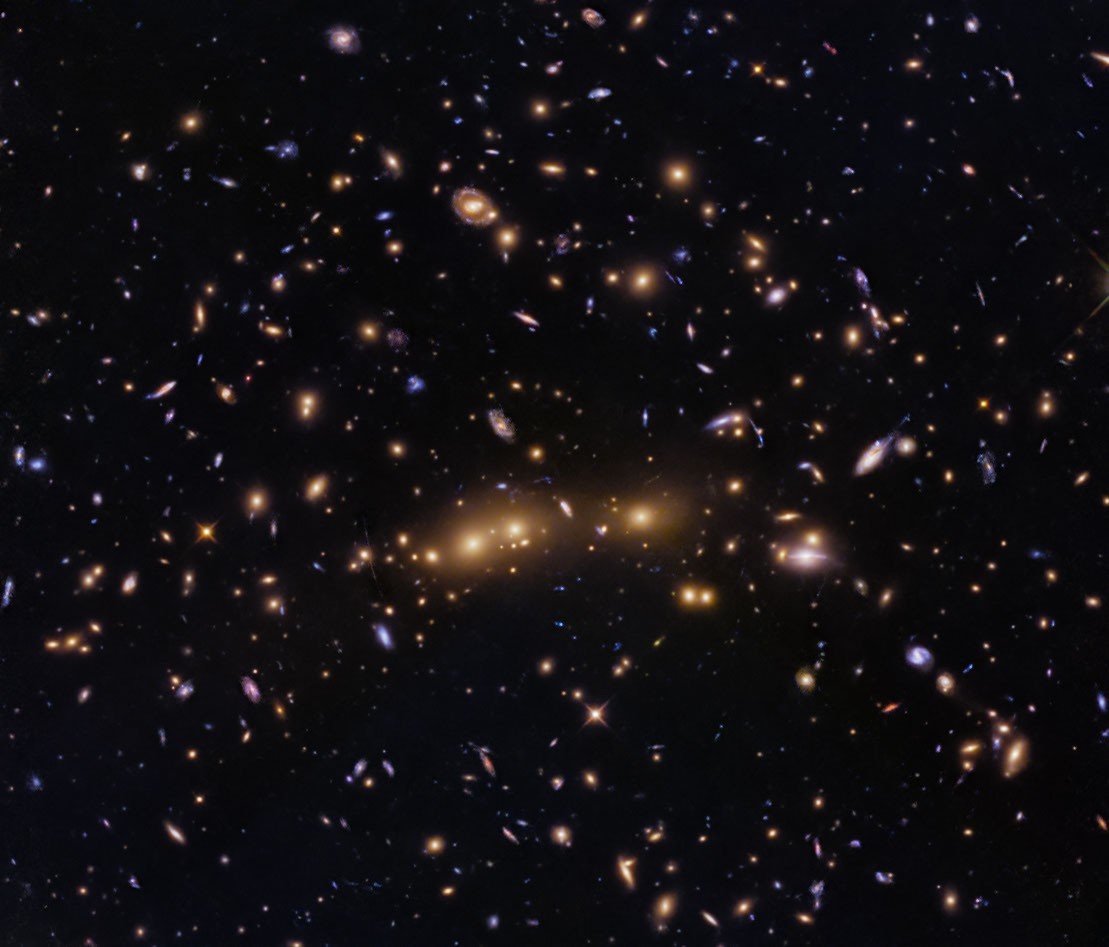
The Hubble Space Telescope has captured images of CL0016+1609, also known as MACS J0018.5+1626, a galaxy cluster undergoing a dramatic collision. X-ray observations from NASA instruments revealed that what appears as a single structure is actually two separate clusters merging directly along Earth's line of sight.
This system ranks among the most intensively observed galaxy clusters at X-ray and radio wavelengths. The merger dynamics offer astronomers a rare laboratory for studying how massive structures collide and interact across cosmic scales. Galaxy cluster mergers rank among the most energetic events in the universe, generating tremendous heat and unleashing gravitational forces that reshape the galaxies within them.
The dual observations across multiple wavelengths, including visible light from Hubble and X-ray data from space-based observatories, provide complementary views of the merger process. X-ray emissions trace hot gas heated to millions of degrees during the collision. Hubble's visible-light imagery captures the distribution of galaxies and reveals structural details obscured in X-ray data alone.
Studying merging clusters illuminates fundamental questions about galaxy evolution and dark matter distribution. During these collisions, galaxies can interact gravitationally, triggering bursts of star formation or feeding supermassive black holes. The visible matter in the colliding galaxies often slows due to drag forces, while dark matter passes through largely unimpeded, creating a separation between the two components that gravitational lensing can reveal.
CL0016+1609 provides an exceptional opportunity because the merger geometry, viewed edge-on along our sightline, allows researchers to map the complex dynamics of two clusters in collision. Such observations test models of structure formation in the universe and refine our understanding of how the cosmic web assembled over billions of years. The extensive prior observations at X-ray and radio waveleng