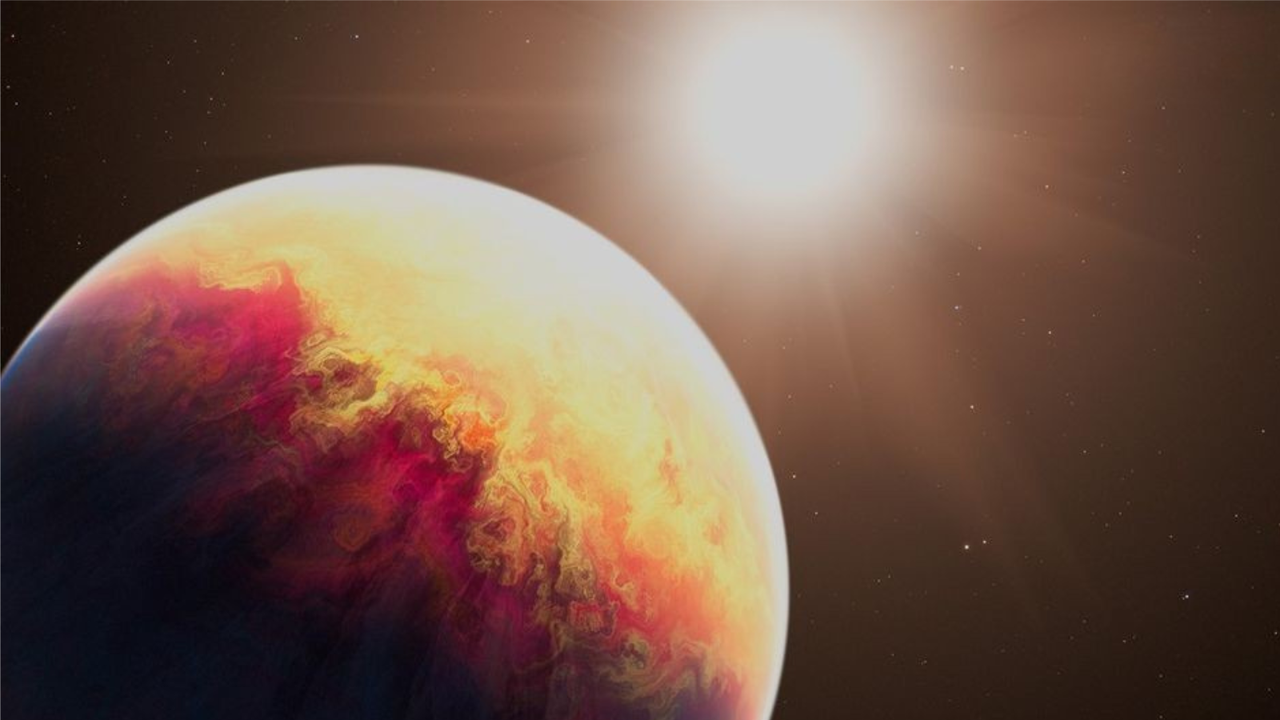
The James Webb Space Telescope has detected an exoplanet experiencing extreme temperatures from its parent star, adding another entry to the catalog of scorching worlds orbiting close to their suns.
Astronomers using JWST identified this "Hot Jupiter" class exoplanet during observations that reveal the brutal conditions planets can endure when orbiting too near their host stars. Hot Jupiters represent a class of gas giants that defy conventional planetary formation theory. These massive worlds exist in orbital zones where models predicted only rocky planets should form, yet they orbit at distances closer than Mercury circles our sun.
The discovery underscores JWST's capability to characterize exoplanet atmospheres and surface conditions with unprecedented precision. The telescope's infrared instruments detect thermal radiation directly from distant worlds, allowing astronomers to map temperature variations and identify atmospheric composition. This particular exoplanet ranks among the most extreme examples, with stellar radiation cooking its atmosphere to extraordinary temperatures.
Hot Jupiters generate crucial questions about planetary migration and system evolution. Their presence close to their stars suggests these gas giants formed farther out and migrated inward, a process that remains incompletely understood. Each discovery helps constrain models of how planetary systems develop and reorganize over billions of years.
JWST's infrared sensitivity proves essential for this work. Visible-light telescopes struggle to penetrate the glare of host stars when studying nearby exoplanets, but JWST's thermal imaging cuts through this interference. The telescope can measure atmospheric features, detect molecular signatures, and track temperature patterns across a world's day-night terminator.
This discovery expands humanity's census of extreme exoplanets and demonstrates that planetary environments exist far beyond Earth's experience. Understanding these roasted worlds illuminates the range of conditions planets can survive and refines our models of how solar systems form and evolve. Each Hot Jupiter observation brings astronom