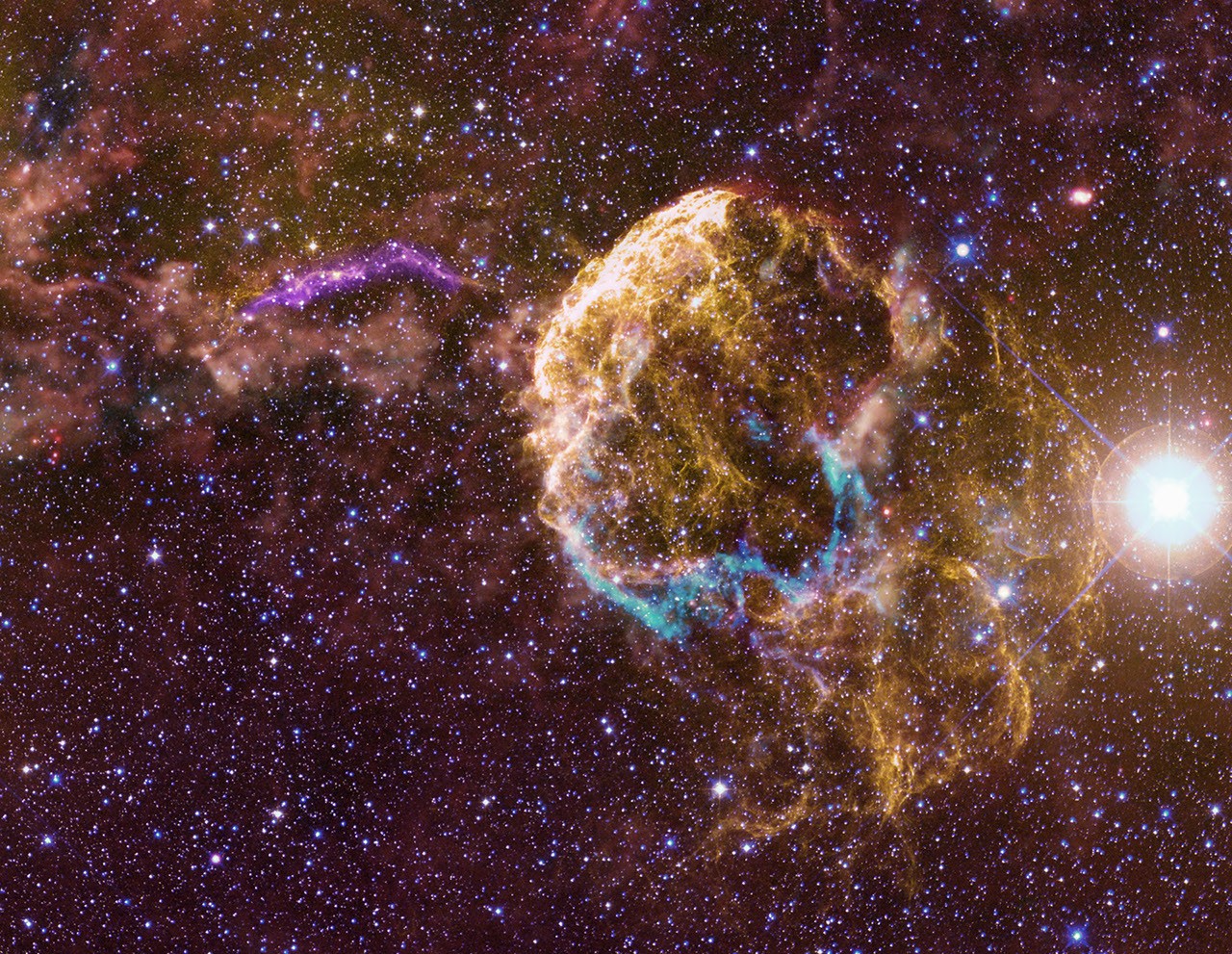
NASA's Fermi Gamma-ray Space Telescope has identified evidence of paired supernova remnants that originated from a binary star system. Researchers analyzing the two remnants concluded that the first stellar explosion ejected its companion star into space at extreme velocity. The surviving star continued traveling through the cosmos for millennia before undergoing its own catastrophic collapse and explosion.
The discovery demonstrates how binary star systems can produce sequential supernovae separated by thousands of years. When the initial massive star reached the end of its life, it detonated as a supernova. The blast imparted enormous momentum to the orbiting companion, transforming it into a runaway star. This ejected star then traversed interstellar space for an extended period before accumulating enough mass or reaching instability to trigger its own supernova event.
Fermi's gamma-ray detection capabilities proved essential for this investigation. The telescope observes high-energy radiation emitted by supernova remnants as they expand and interact with the surrounding interstellar medium. By analyzing the gamma-ray signatures and spatial distribution of both remnants, researchers traced their origins back to a common binary system.
This finding refines our understanding of stellar evolution in multiple star systems. Binary stars evolve differently than isolated stars because they exchange mass and gravitational influence over their lifespans. The timing, energy, and trajectories of their explosions reveal details about how stellar binaries age and ultimately terminate.
The study also illustrates how supernova remnants serve as cosmic laboratories. These expanding shells of hot gas and energized particles preserve physical records of their explosive origins. Fermi's observations of the gamma-ray emission patterns allowed scientists to reconstruct the sequence of events and calculate the time interval between the two detonations.
Understanding sibling supernovae contributes to broader knowledge of supernova populations and their role in cosmic chemistry. Each explosion sc