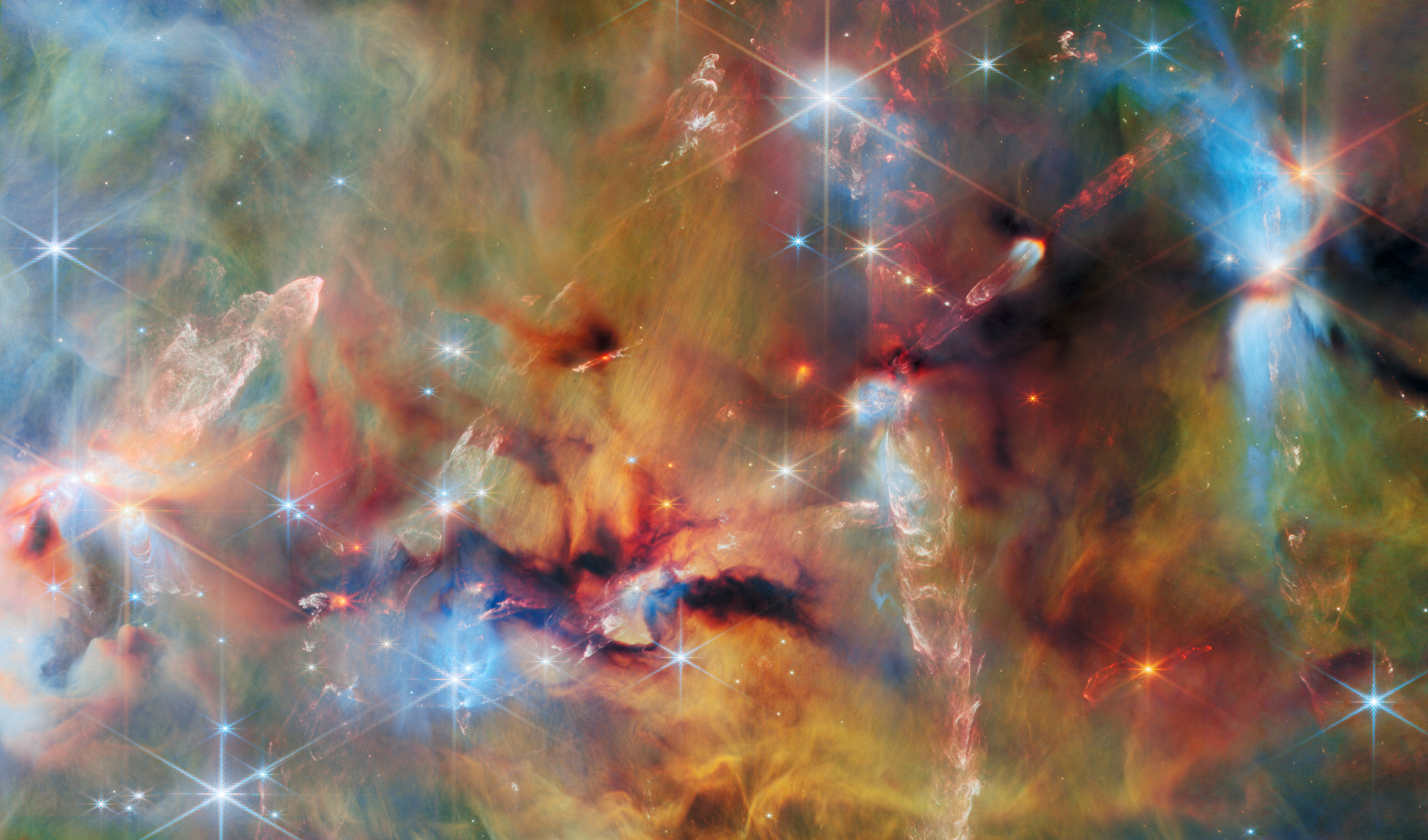
NASA's James Webb Space Telescope captured a landmark image of star formation in the Orion Molecular Cloud, released June 5, 2026. The observation reveals the complete lifecycle of stellar birth, from the earliest embryonic stages through the development of protoplanetary discs that will eventually spawn planets.
The Orion Molecular Cloud stretches across a massive filament of cold gas and dust located beyond the visible Orion Nebula. This region serves as a stellar nursery where gravitational collapse transforms diffuse material into newborn stars. Webb's infrared capabilities penetrate the dense dust that visible-light telescopes cannot see, exposing the hidden mechanics of star formation that occur over millions of years.
The image documents multiple evolutionary stages simultaneously. The youngest stellar embryos appear as dense concentrations within the molecular cloud, barely past the point of gravitational collapse. More mature protostars radiate infrared heat as they accumulate material from their surroundings. The most developed objects show protoplanetary discs, rotating structures of gas and dust orbiting young stars where planets will eventually coalesce.
This single observation compresses what astronomers typically study across separate regions into one comprehensive view. Previous telescopes like Spitzer captured pieces of this puzzle, but Webb's superior resolution and sensitivity reveal details that reshape our understanding of how stars and planetary systems form.
The Orion Molecular Cloud lies approximately 1,350 light-years from Earth, making it one of the nearest active star-forming regions. Its proximity allows Webb to resolve individual objects and structures that remain undetectable in more distant galaxies. These observations directly inform models of planetary formation and constrain theories about the timescales governing the birth of stellar systems.
Webb's infrared vision proves essential for studying star formation because dust grains block visible light but transmit infrared radiation. This wavelength regime reveals the thermal signatures of