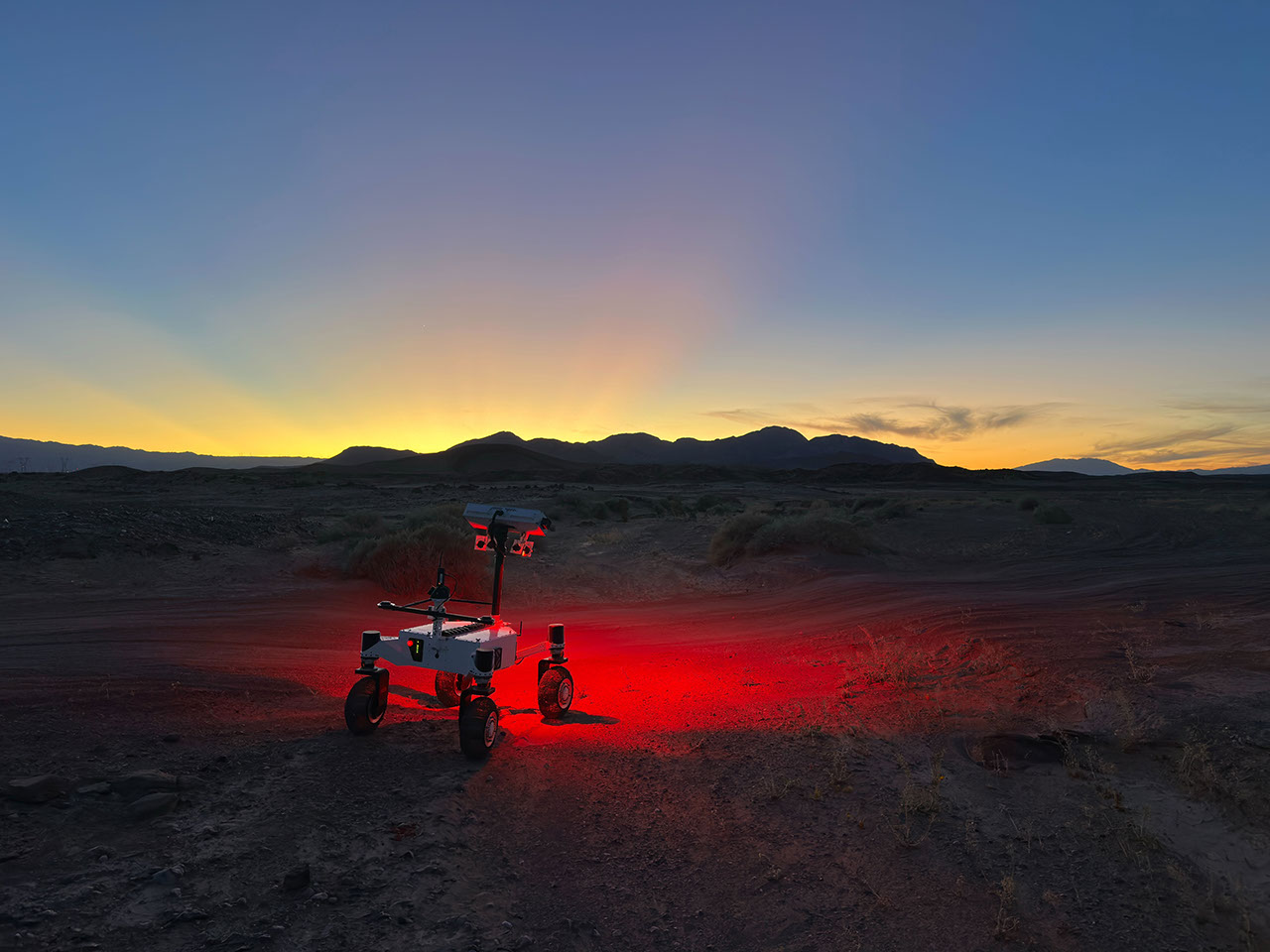
NASA's Jet Propulsion Laboratory tested ERNEST, an advanced four-wheel rover prototype, across the Colorado Desert near Plaster City, California, in March 2026. The vehicle represents a leap forward in autonomous navigation technology designed for extreme planetary terrain.
ERNEST stands for Exploration Rover for Navigating Extreme Sloped Terrain. The rover incorporates sophisticated autonomy software that enables it to traverse challenging landscapes without constant human intervention from Earth. This capability addresses a fundamental challenge in deep space exploration. Current rovers on Mars operate with significant communication delays, forcing them to move cautiously and await instruction cycles that can stretch to hours. ERNEST's onboard autonomy software compresses decision-making into the rover itself, allowing faster traversal across unforgiving ground.
The Colorado Desert test site provided ideal conditions for evaluating the rover's performance on steep slopes and irregular surfaces. JPL engineers focused on validating the autonomy algorithms that let ERNEST navigate obstacles, assess terrain safety, and adjust its path in real time. This capability becomes essential for future lunar missions and Mars exploration, where terrain complexity often exceeds what rovers encounter on established routes.
The prototype's four-wheel design offers advantages over larger, heavier rovers currently operating on Mars. Greater maneuverability on sloped terrain and reduced mass requirements align with emerging concepts for rapid reconnaissance missions and resource surveys. Enhanced autonomy also reduces operational costs by requiring fewer human operators and shorter turnaround times between commands and response.
Future generations of NASA rovers will benefit from ERNEST's testbed data. The technology could support expeditions to challenging locations like the Moon's permanently shadowed craters, where direct navigation challenges demand precisely this kind of autonomous decision-making. As NASA plans increasingly ambitious missions to the lunar south pole and Mars canyon systems, rovers that think independently represent the next evolution in planetary exploration.