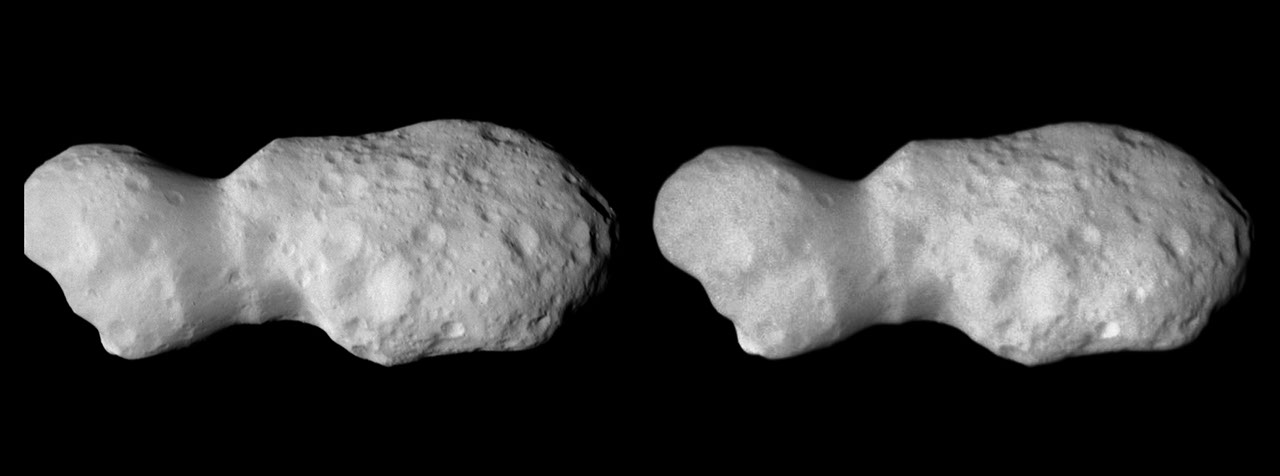
NASA's Lucy spacecraft has revealed that even small asteroids possess dramatic histories. During its 2023 flyby of asteroid Donaldjohanson, Lucy obtained detailed images showing the object to be a peanut-shaped body with a pronounced wobble. The asteroid formed roughly 155 million years ago when fragments coalesced following a violent collision in the main asteroid belt.
The morphology and rotational characteristics of Donaldjohanson indicate substantial geological activity during its existence. The peanut configuration suggests the asteroid may result from a contact binary, two bodies in close orbital proximity that eventually merged. Donaldjohanson's wobble reveals its rotation remains dynamically unstable, possibly caused by the asymmetrical distribution of mass resulting from its formation process.
Lucy's observations contribute to the Trojan asteroid campaign, which aims to characterize bodies that Jupiter's gravity captured into stable orbital zones 4.5 billion years ago. Understanding these ancient objects provides direct evidence about the solar system's early composition and the collisional history of planetary formation. Donaldjohanson itself may represent debris from a catastrophic collision that occurred billions of years ago, preserving its fragments in their current configuration.
The Lucy mission, launched in 2021, follows a 12-year trajectory designed to encounter eight asteroids, including six Trojans and two main-belt objects. Named after the 3.2-million-year-old hominin skeleton that revolutionized paleontology, the spacecraft carries instruments capable of resolving features smaller than 100 meters across from flyby distances.
Lucy's findings reshape our understanding of asteroid population dynamics and collisional processes. The discovery that small bodies like Donaldjohanson retain complex structural memories of ancient impacts informs models of planetary accretion and the compositional stratification of the early solar nebula. Each flyby accumulates data on asteroid