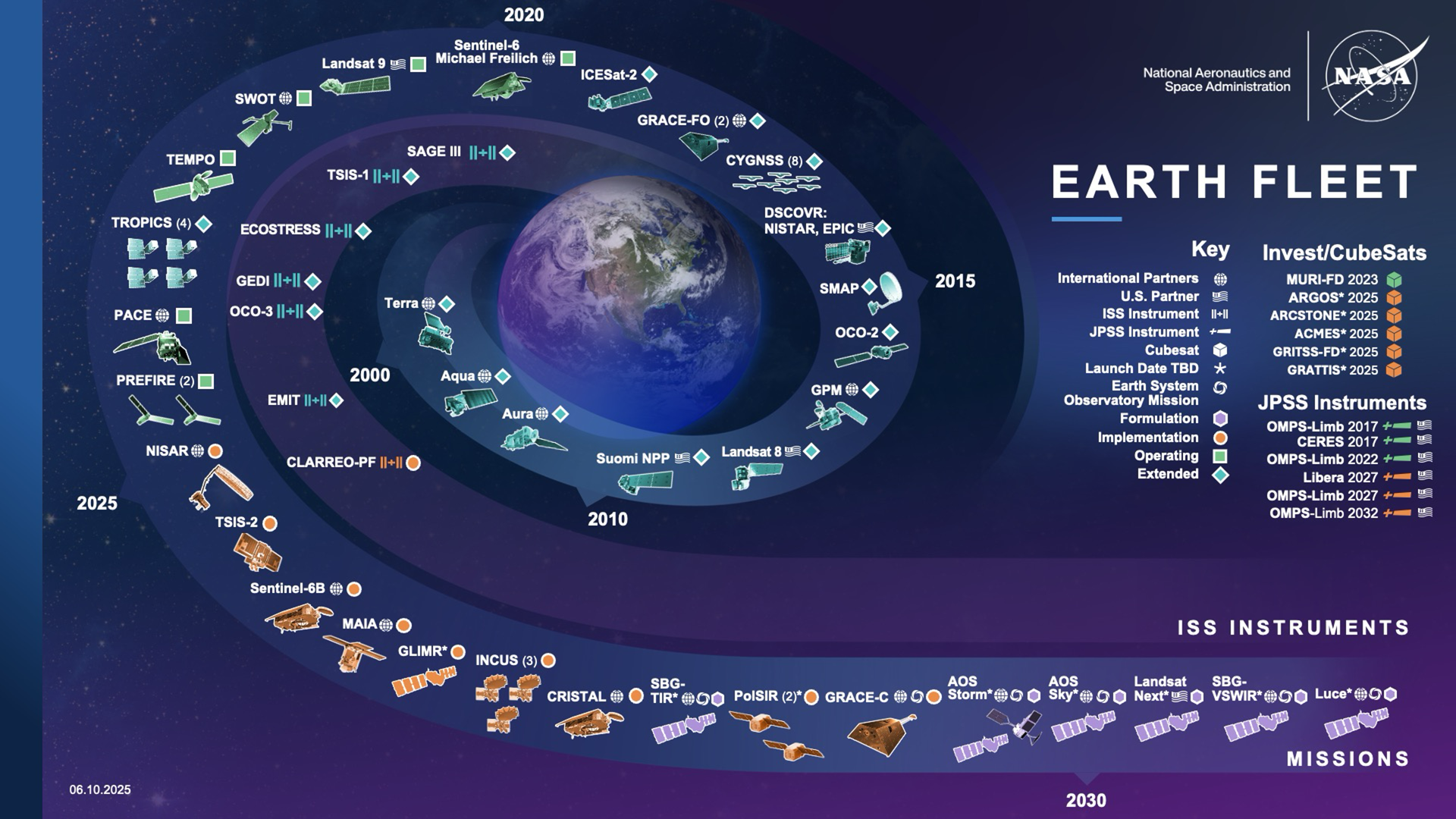
NASA's Earth-observing satellites generate some of the agency's most consequential data, tracking atmospheric aerosols, soil moisture, and land-cover changes across decades. The Earth Science Division (ESD) manages this expansive portfolio of missions, delivering information that shapes global climate research, agricultural planning, and environmental policy.
These satellite networks observe Earth's systems with unprecedented precision. They monitor how particles move through the atmosphere, affecting weather and climate. They measure water infiltration through soil layers, critical for understanding drought and flood risks. They detect shifts in vegetation and urban sprawl across continents, providing baseline data for land-use planning and conservation efforts.
The scope of Earth observation work spans multiple NASA missions working in concert. Satellites in polar orbits capture global coverage daily. Others focus on specific phenomena like ocean color, sea surface temperature, and atmospheric chemistry. Together, they create a real-time portrait of a dynamic planet.
Betsy Ford, featured in this story, works within NASA's Earth Science Division to coordinate this observational architecture. The division manages missions collecting data used by climate modelers, agricultural scientists, disaster response teams, and government agencies worldwide. When hurricanes form, these satellites track them. When droughts threaten crop yields, the data helps predict impacts. When forests burn, the observations document changes in real time.
This Earth observation capability represents decades of investment in space-based sensing technology. The data streams flow continuously to scientists, policymakers, and planners who depend on accurate, timely information about our changing planet. Unlike deep-space astronomy or lunar exploration, Earth observation directly supports decisions affecting billions of people daily, from water management to renewable energy deployment to climate adaptation strategies.
NASA's Earth-observing constellation stands as the agency's most practical contribution to understanding and responding to global environmental change.