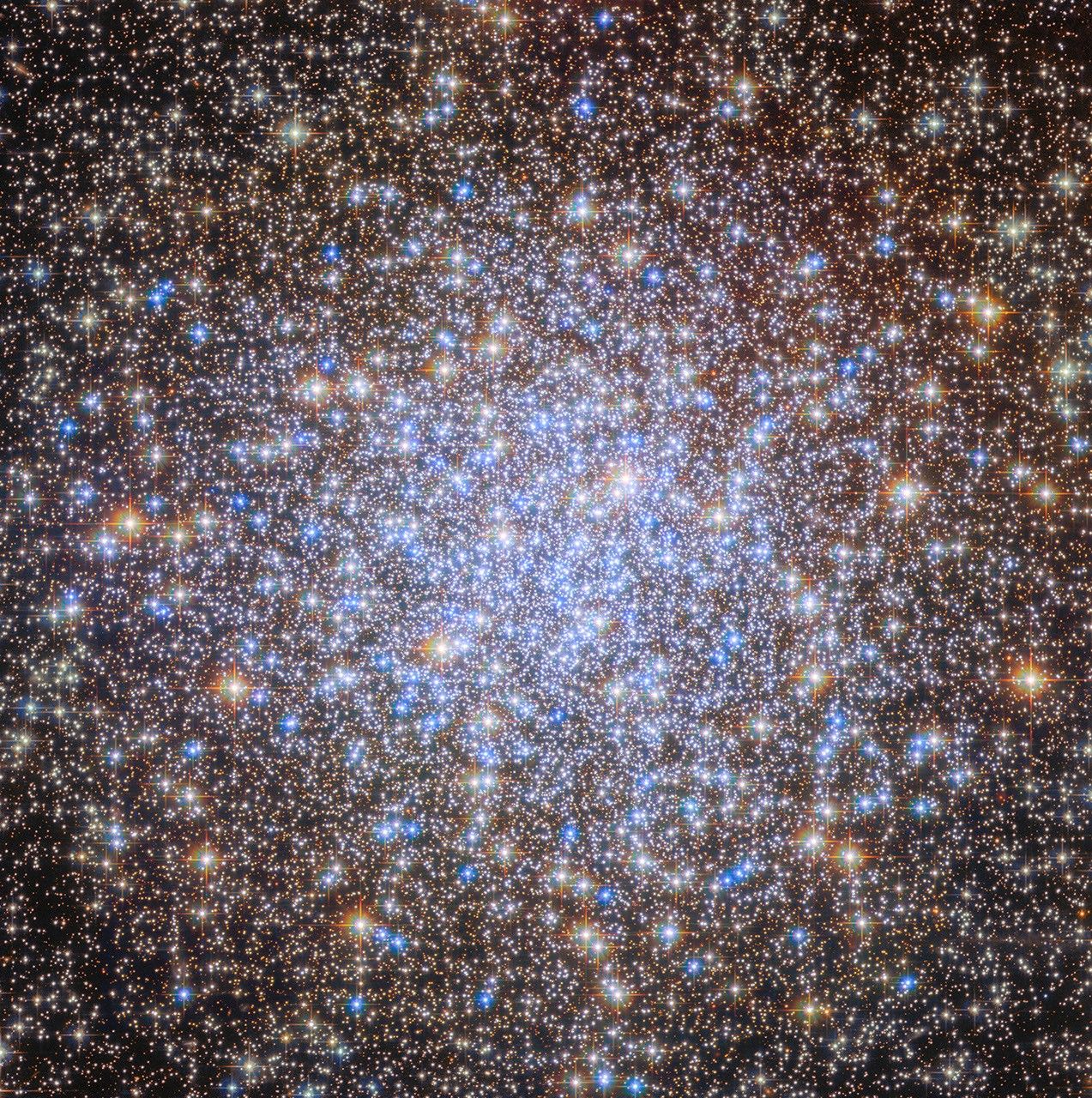
The James Webb Space Telescope has captured NGC 6723, a globular cluster in Sagittarius known as the Chandelier Cluster. Located 27,000 light-years from Earth, this dense grouping contains some of the universe's oldest stars.
Globular clusters represent ancient stellar populations bound together by gravity into roughly spherical arrangements. NGC 6723 displays the characteristic architecture of these systems: thousands of stars compressed into a relatively compact region of space. The cluster's nickname derives from its visual resemblance to a crystalline chandelier, with individual stars scattered throughout like points of light.
Webb's infrared capabilities reveal details previous telescopes could not resolve. The observatory penetrates dust clouds that obscure visible light, exposing the underlying stellar populations and their ages. Stars in NGC 6723 formed during the early universe, making them approximately 10 billion years old. Studying such ancient clusters provides astronomers with direct measurements of stellar evolution and the chemical composition of the early galaxy.
Globular clusters orbit in the galactic halo surrounding spiral galaxies like the Milky Way. Their preservation across cosmic time offers windows into galactic formation and assembly. Each star within these clusters follows a different evolutionary trajectory based on its initial mass, yet all share similar ages and chemical origins. This homogeneity makes globular clusters natural laboratories for understanding stellar physics without the confounding variables present in younger, more dispersed stellar populations.
The image released June 26, 2026, demonstrates Webb's ability to resolve individual stars within crowded fields. This capability transforms how astronomers approach distance measurements, age determinations, and chemical analysis across the local universe. NGC 6723 remains one of thousands of globular clusters orbiting the Milky Way, each containing centuries of stellar data waiting for analysis.