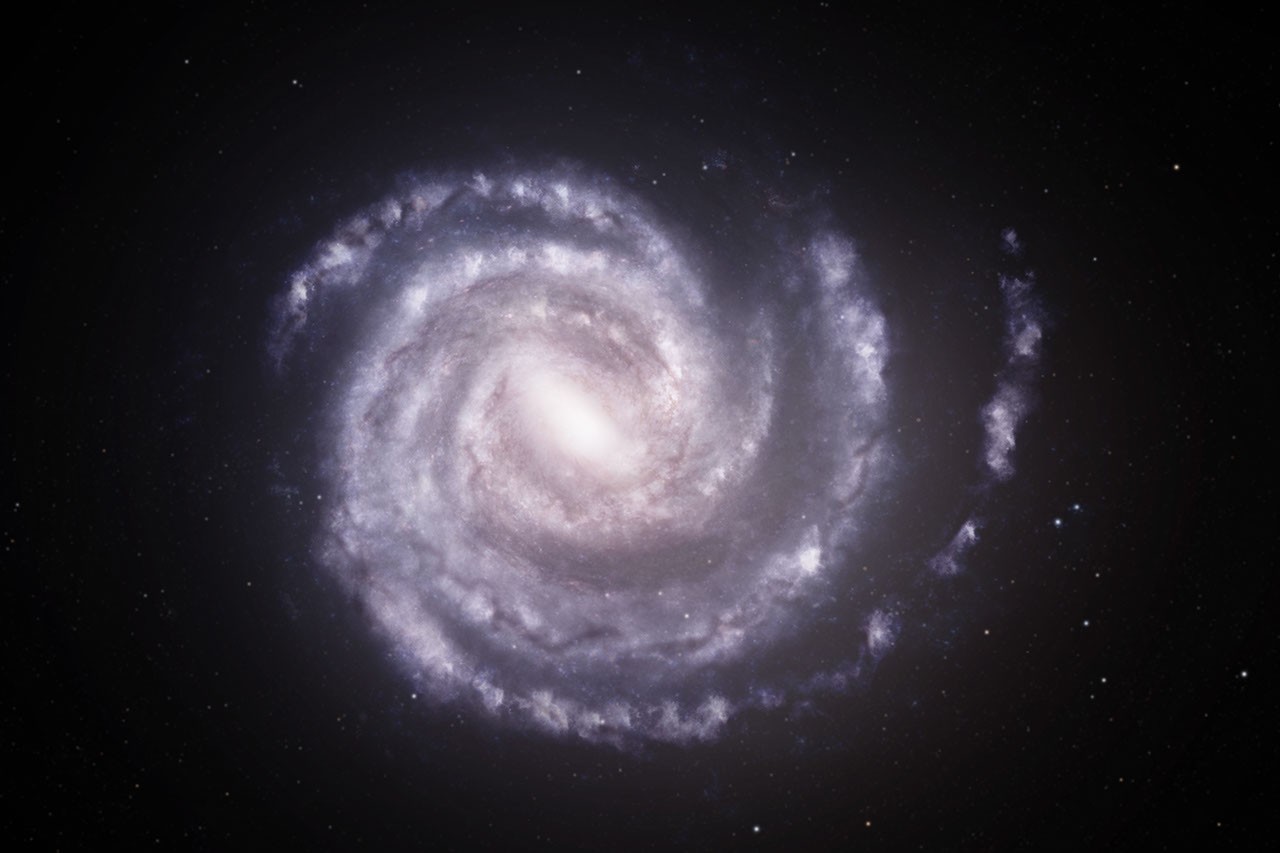
NASA's Chandra X-ray Observatory has detected evidence that the Milky Way's outer spiral arms extend farther than current models suggest. By measuring distances to dust clouds with precision, astronomers have gathered data that challenges existing maps of galactic structure.
The discovery emerges from Chandra's unique capability to observe X-rays from hot gas and stellar remnants across vast distances. These observations allowed researchers to triangulate the positions of dust clouds with greater accuracy than previous optical surveys could achieve. The outer spiral arms represent the galaxy's farthest structures, and their true extent has remained difficult to pin down because dust obscures visible light.
Understanding the Milky Way's full architecture matters for several reasons. The galaxy's spiral structure traces regions where star formation concentrates and where density waves propagate through the disk. Getting the geometry right helps astronomers model how the galaxy evolved and how it continues to evolve today. It also provides context for studying similar spiral galaxies elsewhere in the universe, since our own serves as the closest laboratory for galactic physics.
The finding suggests that previously mapped boundaries may underestimate the galaxy's true reach. A wider spiral structure implies more material resides in the outer regions than expected. This has ramifications for estimating the Milky Way's total mass, its gravitational influence on satellite galaxies, and the distribution of stars and gas throughout the disk.
Chandra's role in this discovery highlights the power of X-ray astronomy for large-scale structure studies. While X-rays typically reveal violent phenomena like supernovae and black holes, they also illuminate extended hot gas that traces the underlying skeleton of galaxies. As astronomers refine their measurements using Chandra data, they will build increasingly precise three-dimensional models of the Milky Way's form. These models will anchor our understanding of galactic architecture for decades to come.