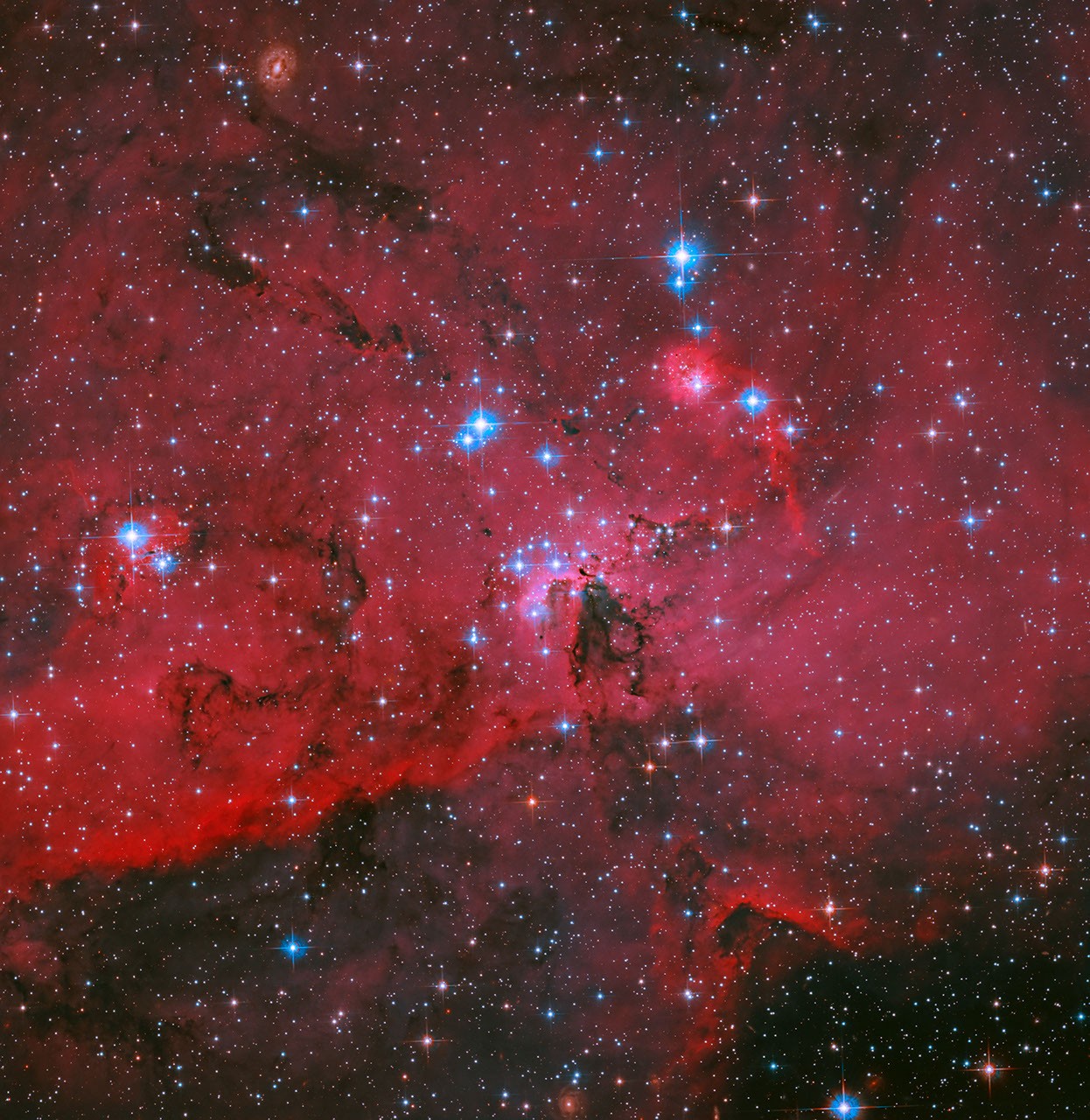
NASA's Hubble Space Telescope has captured a striking image of a stellar nursery where young, hot stars ignite against clouds of hydrogen gas glowing deep red. The photograph shows a contrast between the intense blue and white light emitted by massive newborn stars and the crimson haze surrounding them, created by the ionized hydrogen gas that fills the region.
This type of emission nebula forms when ultraviolet radiation from young, massive stars energizes surrounding hydrogen atoms, causing them to glow. The blue and white stars visible in the image represent some of the hottest and most massive stellar objects in the universe. Their intense radiation carves out cavities in the gas clouds and sculpts the surrounding nebular material into complex structures.
Hubble's Wide Field Camera 3 continues to document stellar birth regions across the galaxy with unprecedented clarity. These observations help astronomers understand how massive stars form, evolve, and interact with their natal environments. The telescope's ability to resolve individual stars within crowded stellar clusters and nebulae provides data that ground-based observatories cannot match.
The Hubble Space Telescope, a joint mission between NASA and the European Space Agency operating since 1990, remains one of the most productive scientific instruments ever deployed. Over three decades of operation, it has fundamentally transformed our knowledge of stellar formation, galactic structure, and cosmological distances.
Images like this one serve both scientific and educational purposes. They reveal the active processes occurring in star-forming regions while demonstrating the raw power of stellar physics. The vivid colors represent genuine astrophysical phenomena captured across multiple wavelengths, not artistic enhancements. Understanding these nebulae helps astronomers refine models of how stars form and how stellar feedback shapes galaxies across the universe.